
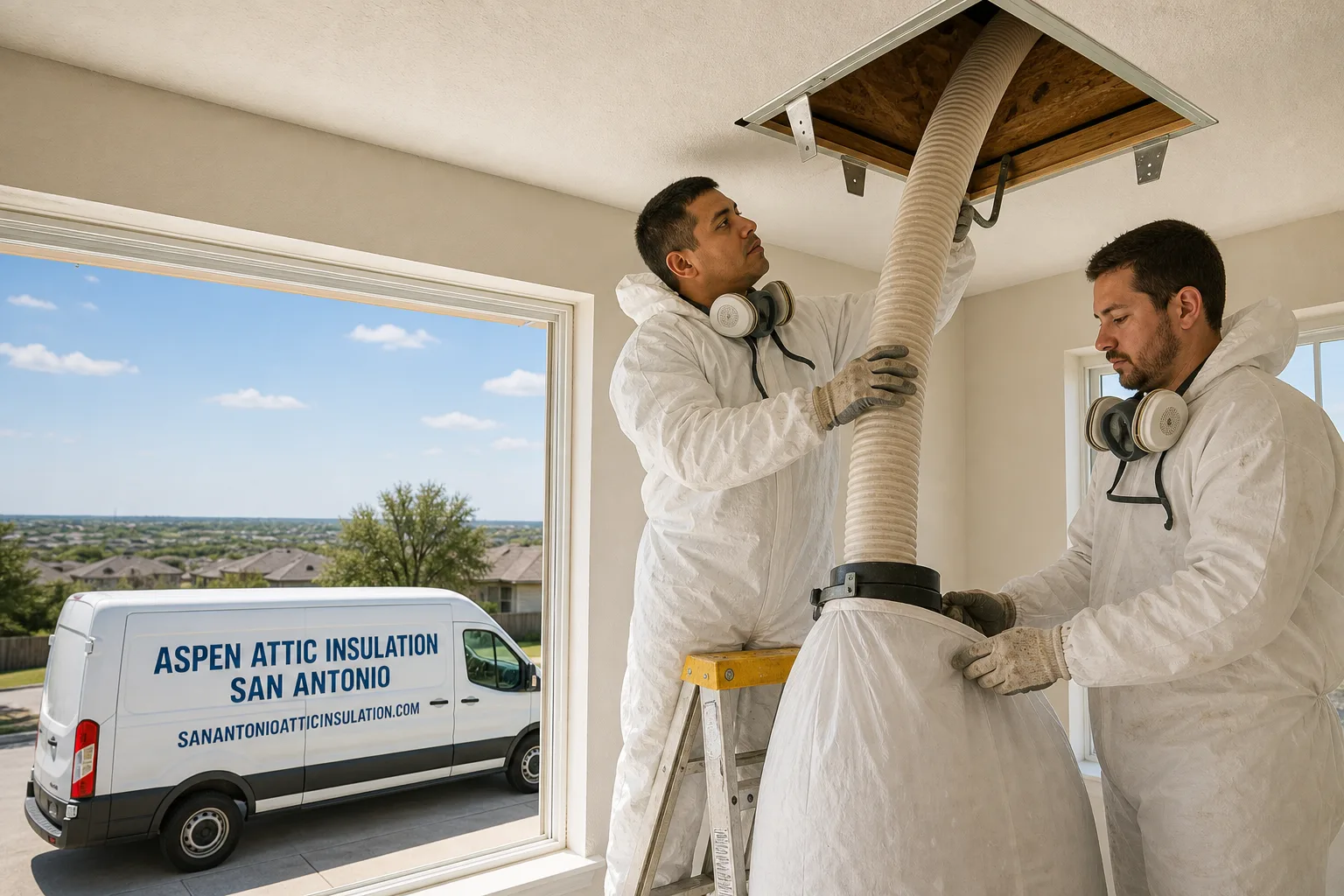
Fast, Reliable Spray Foam Insulation Across Leon Valley
Spray foam insulation in Leon Valley typically costs $1.50 to $4.50 per board foot installed, depending on whether you need open-cell or closed-cell foam. Most homes here fall in the $1,800 to $6,800 range for a full attic or rim joist retrofit. We dispatch crews to Leon Valley daily from our San Antonio office, and a live person answers at (361) 213-9499 whenever you call.
We know Leon Valley homes. We know the 1960s ranch off Poss Road with the cramped hallway closet attic access. We know the slab-on-grade foundation homes where humidity creeps up through the slab edges. And we know the property owners who have been fighting rodent intrusion in original batt insulation for years. That’s what makes this page different: it’s written for your house, your neighborhood, your specific problems. Not a template.
Why Aspen Attic Insulation San Antonio Is Leon Valley’s Preferred Spray Foam Insulation Company
Homeowners in Leon Valley hire us because we show up with a name, a face, and a written price before the first can of foam ever opens. Garrett Sloane runs our crews to the Threshold Verified standard: every technician is background-checked, identity-verified, and arrives in a clean marked uniform with a photo ID badge. You’ll get the technician’s name and photo sent to you before the visit. If someone else shows up, the visit is free.
We’ve worked in the Huebner Creek area, along Bandera Road, and through the neighborhoods around Evers Road and Poss Road. The homes we see were mostly built between 1960 and 1985, and their original insulation has typically settled, sagged, or been chewed through. Leon Valley homeowners don’t just want a lower cooling bill. They want the air sealing that stops humidity and rodents at the source.
Our response time to Leon Valley for standard estimates is typically same-week, and we answer the phone around the clock. No voicemail loops. When you call (361) 213-9499, a person picks up.
Key takeaways:
- Written price before any work starts. No surprises after.
- 365-Day Done Right Promise covers labor and materials. Free second visit if the repair fails.
- Technician’s name and photo sent before the visit. Background-checked, photo-badged, marked uniform.
- Materials from Demilec, Owens Corning, and Johns Manville, matched to your specific job.
Spray Foam Wall Insulation in Leon Valley
Spray Foam Wall Insulation in Leon Valley is the retrofit that makes the biggest difference for homes built on slab foundations with no crawlspace. In these 1960s-to-1980s single-family homes, exterior walls were often insulated with thin fiberglass batts that have slumped inside the wall cavities, leaving gaps at the top plates. Closed-cell spray foam fills those cavities and air-seals the wall assembly in one step. Wall spray foam in Leon Valley runs $2.00 to $4.50 per board foot, with a typical exterior wall retrofit for a 1,800-square-foot ranch costing between $3,500 and $7,200.
When a Leon Valley homeowner needs wall foam, it’s usually because they’ve noticed uneven room temperatures, high cooling bills in August, or a musty smell coming from inside the walls. The moisture problem is real: Leon Valley’s humidity pushes water vapor through porous wall assemblies, and open-cell foam without the right vapor management can absorb that moisture. We specify Demilec closed-cell products for most wall retrofits here specifically because the closed-cell structure blocks both air and water vapor.
When wall foam beats re-insulating with batts
If your home has settled batts and you’re planning to open walls anyway for rewiring or plumbing, spray foam is the smarter spec. It conforms to the irregular stud bays common in older Leon Valley framing and reduces air leakage far better than any batt product. For homes staying in place with no wall opening planned, we can also inject foam through small access holes, which keeps drywall disruption minimal.
Vapor control in Leon Valley’s humid climate
Open-cell foam installed without a vapor retarder in Leon Valley’s high humidity can absorb moisture, lose R-value, and invite mold. That’s a failure mode we see on homes that were insulated by out-of-town crews who didn’t understand the local climate. We always match the foam type to the wall assembly, and in Leon Valley, that usually means closed-cell on exterior walls.
Rim Joist Spray Foam in Leon Valley
Rim Joist Spray Foam in Leon Valley is the single highest-value air-sealing job in slab-on-grade homes. The rim joist, also called the band joist, is the perimeter framing where the floor system meets the foundation. In Leon Valley’s slab homes, this is where hot humid air sneaks in from outside and where rodents often enter. Spraying closed-cell foam along the rim joist in a typical Leon Valley ranch costs $900 to $2,800 depending on linear footage and access, and it usually pays for itself within three to five cooling seasons.
In the Huebner Creek area off Poss Road, we sprayed closed-cell foam along rim joists and top plates of a 1972 ranch with original fiberglass batts that had sagged and been tunneled by rodents. After removing the contaminated batts and sealing the band joist with Demilec spray foam, we cut the homeowner’s cooling load and eliminated the attic’s recurrent mouse odor. This is not a hypothetical. It’s what we do here.
Why the rim joist matters in slab homes
Slab-on-grade foundations mean there’s no crawlspace to ventilate, which sounds good until you realize the rim joist is the only barrier between the conditioned house and the outside air. Leon Valley’s hot, humid summers push air through every unsealed rim joist gap. Closed-cell foam stops air, bulk water, and water vapor at the same joint, which is why we specify it for nearly every rim joist job in Leon Valley.
Rodent sealing with spray foam
Leon Valley’s animal control ordinances exist because the city takes rodent and wildlife problems seriously. But code enforcement only works if the entry points are sealed. Spray foam air-seals those entry points. When mice tunnel through fiberglass, they leave trails and nesting, but they cannot tunnel through closed-cell foam. We’ve seen it stop recurring mouse odor in attics where trapping alone never solved the problem.
Trusted Brands We Service in Leon Valley
We stock and install materials from Demilec, Owens Corning, and Johns Manville, which means we match the product to the problem instead of forcing one brand onto every job. For closed-cell rim joist and wall work in Leon Valley, we typically run Demilec’s closed-cell products because of their moisture resistance and air-sealing performance. For attic and open-cell retrofit work, we draw on Owens Corning and Johns Manville lines. Local parts availability is rarely an issue: our San Antonio dispatch keeps Leon Valley jobs stocked so crews don’t waste half a day running for supplies. When you call for an estimate, we tell you exactly which material we’re quoting, not just “spray foam.”
Common Spray Foam Insulation Problems We See in Leon Valley Homes
- Open-cell foam without vapor control. Leon Valley’s high humidity means open-cell foam on exterior walls can absorb moisture, lose R-value, and grow mold if installed without proper vapor management. We see this on homes done by crews unfamiliar with South Texas conditions.
- Foam sprayed over pest-damaged batts. Some contractors will spray right over old, mouse-tunneled fiberglass. That traps rodent droppings and odors inside the building envelope and violates basic sanitation. We remove contaminated batts before spraying, every time.
- Aggressive expansion on old plumbing. In slab-on-grade homes, expanding foam applied too aggressively around plumbing penetrations can crack brittle 1960s cast-iron drain pipes. We use low-expansion formulations around any penetration near older plumbing.
- Attic access through cramped hallway closets. Many Leon Valley homes have attic access through narrow hallway closets, which makes traditional batt installation slow and disruptive. Spray foam applied through a wand from that access point avoids cutting drywall and reaches areas batts can’t.
Pricing for Spray Foam Insulation in Leon Valley, TX
Here’s what Leon Valley homeowners can expect to pay for spray foam work, based on recent jobs in the area:
- Open-cell attic spray foam: $1.50 to $2.50 per board foot, or $1,800 to $4,500 for a typical 1,500-square-foot attic at 5 to 6 inches of foam.
- Closed-cell rim joist spray foam: $2.50 to $4.00 per board foot, or $900 to $2,800 for a full rim joist on a ranch home.
- Closed-cell wall retrofit (exterior walls): $2.00 to $4.50 per board foot, or $3,500 to $7,200 for an 1,800-square-foot home.
- Garage ceiling spray foam: $1,200 to $3,000 depending on ceiling square footage and whether you want open-cell or closed-cell.
- Spray foam roof deck (hot roof application): $3.50 to $6.00 per board foot, or $5,000 to $12,000 for an average Leon Valley roof deck.
These are real ranges from our written estimates in Leon Valley, not national averages. What moves the number: foam type, square footage, access difficulty, and whether old insulation needs removal first. Every job gets a written price before any work starts. Call (361) 213-9499 and we’ll walk your house, measure, and hand you the number in writing. The estimate is free.
We Also Serve Cities Near Leon Valley
Our crews cover Leon Valley plus the surrounding communities of San Antonio, Schertz, Universal City, and Live Oak. If you’re in one of those areas and need Spray Foam Insulation, we bring the same written-price standard and 365-Day Done Right Promise. Learn more about our work in this area on our Leon Valley page.
Serving Leon Valley, TX - Our Local Coverage Area
We’re based in the Leon Valley area and know this community well. Use the map below to see our service coverage - if you’re nearby, we can almost certainly help.
FAQs About Spray Foam Insulation in Leon Valley
Yes. Closed-cell spray foam air-seals the rim joist, top plates, and wall penetrations where rodents enter, and rodents cannot tunnel through cured closed-cell foam the way they tunnel through fiberglass batts. If your attic has existing pest-damaged insulation, we remove it before spraying so droppings and odors don’t get trapped inside the building envelope. Call (361) 213-9499 and we’ll inspect your entry points during the free estimate.
Yes, and it’s actually one of the best reasons to choose spray foam in Leon Valley. The spray foam wand fits through narrow access hatches and reaches into tight corners where batt rolls and loose-fill hoses are hard to maneuver. That means no cutting drywall and no moving hallway furniture out of the way.
Yes, when installed correctly. The key is using low-expansion foam around plumbing penetrations so the foam doesn’t pressure brittle 1960s cast-iron drain pipes. Our crews are trained to identify older plumbing and adjust foam expansion rates accordingly. The rim joist and wall applications we do in Leon Valley are standard practice for slab homes.
Spray foam air-seals as it insulates, which blown-in fiberglass or cellulose does not. In Leon Valley’s high humidity, that air sealing is the difference between a dry, R-value-holding attic and one where moisture cycles through, degrading performance. Blown-in is a great budget option for open attics, but for rim joists, wall cavities, and rodent-prone areas, spray foam is the stronger specification.
Leon Valley follows Texas state building codes, which require thermal barriers over spray foam in certain locations and specific ignition barrier treatments in attics. Our crews are familiar with the city’s inspection process and we quote jobs to meet code the first time, so you’re not paying for re-inspection or rework. We’ll walk you through the relevant code points during your estimate.
If you’re ready to solve the twin problems of high cooling bills and air leaks, call (361) 213-9499. We’ll send a technician you know by name, with a written price in hand, and a 365-day guarantee behind the work. That’s how we do it in Leon Valley.
Written by Garrett Sloane, Owner at Aspen Attic Insulation San Antonio, serving Leon Valley. Part of the Threshold Group family, founded 2002.