
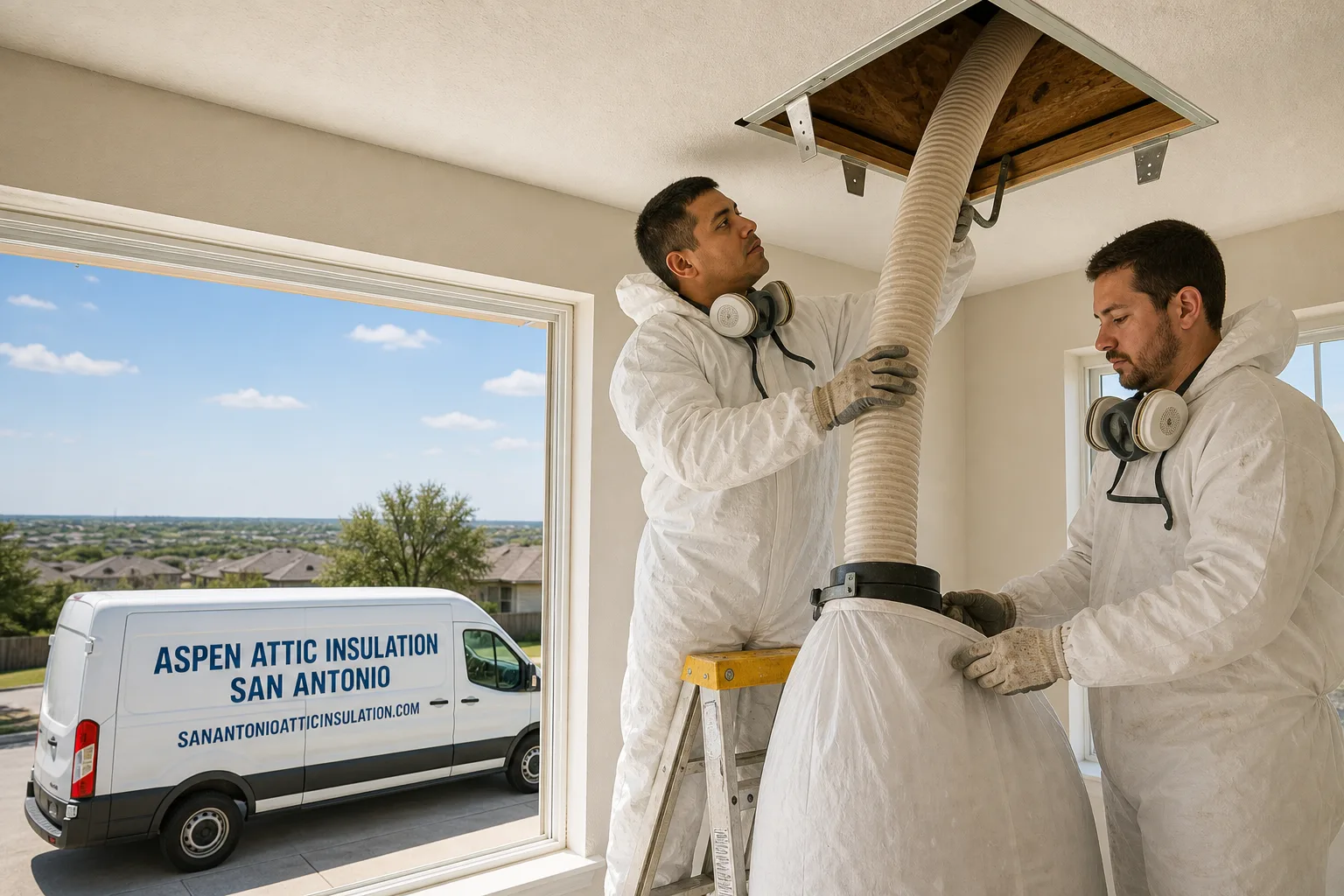
Fast, Reliable Blown In Insulation Across Castle Hills
Blown-in insulation in Castle Hills typically runs $1.40 to $3.10 per square foot installed, with most attic retrofits landing between $1,800 and $4,600 depending on depth and prep work. We’re out here regularly, and our crews know exactly what Castle Hills inspectors look for when they sign off on a retrofit. Castle Hills enforces higher insulation R-values than surrounding Bexar County through a local ordinance tied to its municipally owned electric utility. That means the work done in your attic has to pass a city-specific inspection that doesn’t exist in San Antonio, Schertz, or anywhere else nearby. If you want a crew that already knows the code requirements and the inspection sequence, call us at (361) 213-9499.
Why Aspen Attic Insulation San Antonio Is Castle Hills’s Preferred Blown In Insulation Company
Garrett Sloane runs our operation with one rule: the homeowner knows who’s walking up the driveway before the truck parks. Every technician we send into Castle Hills is background-checked, identity-verified, and arrives in a marked uniform with a photo ID badge at the door. You get the tech’s name and photo before the visit. If someone else shows up, the visit is free and we make it right. That’s our interpretation of The Threshold Standard, the verification protocol every Aspen location operates under.
Castle Hills homeowners deal with a specific set of problems: settled rock wool from the Eisenhower administration, city inspections tied to a municipal utility code, and summer heat that punishes under-insulated attics. We see those jobs every week. The difference is we know what the inspector will flag before the inspector arrives, so the project closes in one trip instead of two or three. And every job carries a written price before work starts, backed by our 365-Day Done Right Promise covering labor and materials in writing. If the repair fails within a year, the second visit is free.
Cellulose Insulation in Castle Hills
Cellulose insulation is our most common recommendation for Castle Hills attics, especially the 1950s and 1960s ranch homes that dominate the neighborhood. It’s loose fiber blown into the attic cavity to fill every gap, and it handles the county’s Gulf humidity better than fiberglass batts that leave seams. In Castle Hills, a full cellulose attic retrofit typically runs $1,800 to $4,200, depending on whether the space needs old material removal first.
Blown-In Cellulose Over Old Rock Wool
Many original Castle Hills homes still have rock wool from the original build. That material settles to R-11 or worse over six decades, which fails the city’s elevated R-value requirement. We don’t just blow fresh cellulose on top. The old stuff gets vacuumed out, the attic floor gets air-sealed, and then we bring the space up to code.
When Castle Hills Homeowners Call Us
The usual trigger is an A/C unit running nonstop through July and August. That’s when settled insulation shows its age. The second trigger is a failed city inspection on a DIY job or a handyman retrofit that didn’t meet Castle Hills’ specific ordinance. Either way, we fix the problem and handle the inspection.
Blown In Attic Insulation in Castle Hills
Blown in attic insulation in Castle Hills means loose-fill material applied across the attic floor to hit the R-value the city actually enforces. Most attics here need R-38 minimum under current local ordinance, which is higher than what unincorporated Bexar County requires. A standard blown-in attic job in Castle Hills runs $1,400 to $3,900, with homes that need air-sealing and old insulation removal falling on the higher end.
Air Sealing Before the Blow
Before any loose-fill goes down, the top plates, plumbing penetrations, and recessed light housings need sealing. Otherwise you’re paying to cool air that escapes through gaps the insulation never touches. On the 1960s ranch-style home off Winston Lane, our crew pulled back the attic access and found the original rock wool had settled to just 3 inches, well below Castle Hills’ current code. We vacuumed out the old material, air-sealed the top plates, and blew in GreenFiber cellulose to R-38, then scheduled the city inspection the same week so the project closed in one visit.
Low-Slope Roof Attic Chutes
Castle Hills ranch homes often have low-slope roofs where attic chutes get buried by loose-fill. That cuts soffit airflow, which spikes HVAC runtime in July and can trap moisture along north-facing eaves. We install baffles and keep the soffit vents clear as part of the job, not as an add-on you find out about later.
Trusted Brands We Service in Castle Hills
We stock materials from eight industry-leading manufacturers, and for Castle Hills jobs we typically pull from GreenFiber, Owens Corning, and Demilec. GreenFiber cellulose handles the humidity and fills irregular cavities in older ranch attics well. Owens Corning fiberglass loose-fill gives a clean, consistent R-value at a solid price point. Demilec spray foam comes into play when a Castle Hills homeowner wants the attic sealed and insulated in one pass, particularly on additions or converted garage spaces. We don’t push one product because a warehouse has it in stock. We match the material to the attic and the city inspection requirements.
Common Blown In Insulation Problems We See in Castle Hills Homes
- Settled 1950s rock wool failing inspection: Original rock wool compresses over 60-plus years, often reaching only R-11 or less. Castle Hills’ elevated R-value ordinance means that depth won’t pass a city inspection, forcing a redo if it wasn’t addressed up front.
- Cellulose over old vermiculite without a vapor check: Some older attics still have vermiculite from the original build. Blowing cellulose on top without checking vapor conditions traps Gulf humidity, which leads to mold on north-facing eaves.
- Buried attic chutes in low-slope roofs: Loose-fill pushes into the soffit area on ranch-style homes with shallow roof pitches. The airflow loss drives up HVAC runtime and can create hot spots in the ceiling.
- City inspection failure on previous work: A handyman or a generalist contractor blows in material without knowing Castle Hills’ municipal inspection sequence. The job fails, the homeowner calls us, and we pull it out and redo it properly.
Pricing for Blown In Insulation in Castle Hills, TX
You should know the numbers before anyone walks through your door. For most Castle Hills homes, blown-in attic insulation runs $1.40 to $3.10 per square foot installed. A typical 1,500-square-foot ranch attic lands between $2,100 and $4,600. Cellulose runs on the lower end of that range. Removing old rock wool or vermiculite adds $400 to $900 depending on attic size and access. Air sealing adds $300 to $700. Every quote is written down before work starts, with no post-job numbers. Call (361) 213-9499 and we’ll walk the attic, give you a written price, and schedule the work around the city inspection timeline.
We Also Serve Cities Near Castle Hills
Beyond Castle Hills, our crews serve San Antonio, Schertz, Universal City, and Live Oak. If you’re in one of those areas or you’re just outside the city line, Blown In Insulation work carries the same written price and the same 365-day guarantee. The Blown In Insulation in Castle Hills team handles dispatch for the whole corridor.
Serving Castle Hills, TX - Our Local Coverage Area
We’re based in the Castle Hills area and know this community well. Use the map below to see our service coverage - if you’re nearby, we can almost certainly help.
FAQs About Blown In Insulation in Castle Hills
The contractor handles the full sequence. Castle Hills requires a permit for blown-in insulation work because the city inspection checks R-value compliance against the local ordinance tied to the municipal electric utility. We pull the permit, do the work, and schedule the inspection. You don’t file anything yourself. Call (361) 213-9499 if you’re mid-project and need paperwork sorted out.
Modern cellulose and fiberglass loose-fill are installed at a density that accounts for settling, so the settled depth still meets the R-value Castle Hills enforces. The settlement problems come from the original 1950s rock wool, which compresses permanently over decades. We install to the settled R-value, not the initial loose depth, so you pass inspection and stay compliant.
Summer humidity from the Gulf pushes moisture into attics through gaps and poorly vented eaves. In that environment, cellulose performs better than fiberglass because it’s denser and slows air movement through the insulation layer. If there’s an existing moisture problem or old vermiculite below, we add a vapor check before blowing new material in. The wrong material in a humid attic shows up as mold on north-facing eaves within a few seasons.
You can, but we don’t recommend it and neither does the city inspector. The original rock wool has settled to a fraction of its intended depth, often R-11 or less. Blowing new material on top buries the problem and makes re-air-sealing impossible. We vacuum out the old rock wool, seal the attic floor, and blow in fresh material to the R-value Castle Hills code requires. It costs more up front but it’s the job that passes inspection and actually lowers your cooling bill.
Castle Hills generally enforces R-38 for attic insulation under the local ordinance connected to its municipally owned utility, which is higher than the R-30 baseline common in surrounding Bexar County. The specific code language is available through Castle Hills City Hall and the city’s permitting office. We stay current on the ordinance as it updates, so the number we install to on your job is the one the inspector will check. Call (361) 213-9499 for a free estimate and we’ll confirm the current requirement for your specific attic before we quote the job.
Written by Garrett Sloane, Owner at Aspen Attic Insulation San Antonio, serving Castle Hills with blown-in insulation, attic retrofits, and city-code-compliant insulation work since 2002.