
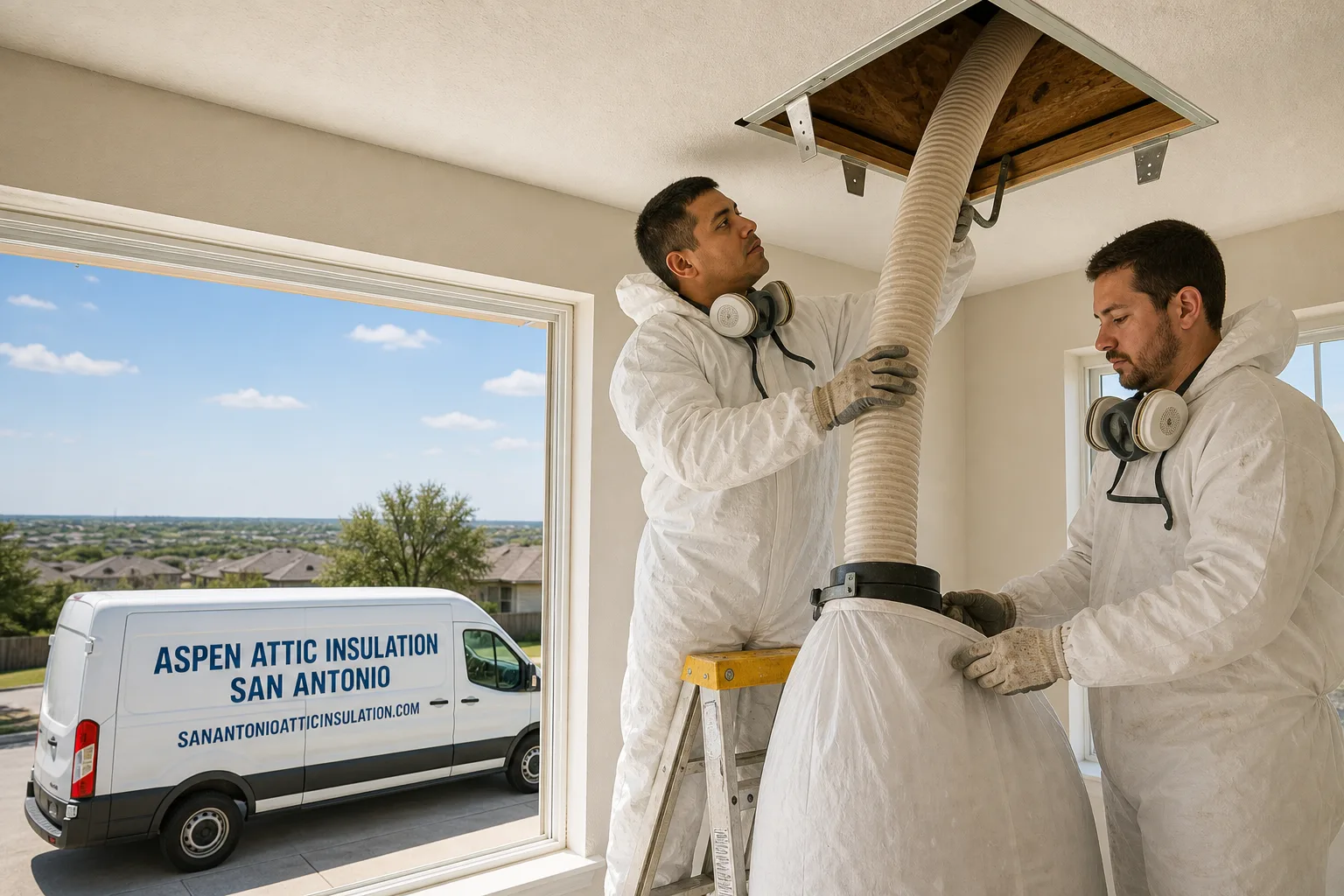
Fast, Reliable Blown In Insulation Across Live Oak
Blown-in insulation in Live Oak typically costs $1.40 to $3.10 per square foot installed, with most single-story ranch homes running $1,900 to $4,300 for a full attic retrofit. We stock fiberglass and cellulose, and our crews reach most Live Oak neighborhoods same-day or next-day from our San Antonio dispatch office. If your attic is sitting at R-11 or R-19 and your AC runs nonstop from May through September, call (361) 213-9499 for a written price before anyone shows up at your door.
Live Oak sits right in the I-35 corridor northeast of San Antonio, where summer highs push into the mid-90s and humidity hangs heavy. The 1970s through 1990s ranch homes that dominate this city were built when insulation was an afterthought. Most attics we inspect here have settled fiberglass or thin cellulose that no longer does its job. That means heat radiates through your ceilings, your air conditioner works harder, and your electric bill climbs every June.
Why Aspen Attic Insulation San Antonio Is Live Oak’s Preferred Blown In Insulation Company
Homeowners in Live Oak don’t want a stranger walking through their front door. We get that. Every technician we send is background-checked, identity-verified, and arrives in a clean marked uniform with a photo ID badge. Before the visit, you receive the tech’s name and photo by text or email. If anyone else shows up, the visit is free and we make it right. That’s the Threshold Standard, and it applies to every job we do in Live Oak.
Garrett Sloane leads our team, and he built this company in 2002 on a simple rule: put the price in writing before any work starts. No post-job surprises, no add-ons at the door. Every insulation job carries our 365-Day Done Right Promise in writing, covering labor and materials for a full year. If a repair fails within that year, we come back and fix it free.
Our crews know Live Oak’s housing stock. We’ve worked in neighborhoods around Toepperwein Road, Judson Road, and the subdivisions off Loop 1604. We know the slab-on-grade foundations, the brick veneer exteriors, the composition shingle roofs, and the vented attics that hold decades of settled insulation. A live person answers the phone 24/7, so when you call (361) 213-9499, you talk to a human, not a voicemail loop.
Blown In Insulation Contractors in Live Oak
Blown In Insulation Contractors in Live Oak handle the heavy work of removing old, settled material and blowing fresh loose-fill insulation into your attic cavity to fill every gap and void. In homes along the I-35 corridor, we typically see R-11 to R-19 in attics that should be at R-38 or higher for this climate. A full attic blow-in for a 1,500 square foot Live Oak ranch runs $1,900 to $3,800 depending on depth, access, and whether we’re removing old material first. That price is written down and handed to you before a single bag is opened.
Air Sealing Before the Blow
Blowing insulation over gaps around can lights, plumbing penetrations, and attic hatches without sealing them first is a waste of material. In Live Oak, those gaps also pull humid air into the attic, which condenses on the underside of the roof deck. We seal the attic floor first, then blow to depth.
Baffles and Soffit Vent Protection
Wind-driven rain from I-35 corridor storms enters through unsealed eaves and gable vents. We install baffles at every soffit vent to keep blown-in insulation from blocking airflow while stopping moisture from reaching the insulation. This is standard on every Live Oak job.
Cellulose Insulation in Live Oak
Cellulose Insulation in Live Oak means dense-packed or loose-fill recycled paper fiber treated with borate for fire and pest resistance. It’s a solid choice for retrofit attics because it settles into irregular cavities and around framing better than fiberglass. In Live Oak’s humid climate, we recommend cellulose specifically for homes with vented attics and good soffit protection, where its higher density helps block radiant heat. A typical cellulose attic blow-in runs $1.60 to $2.90 per square foot, or roughly $2,200 to $4,100 for the average single-story ranch. Written price first, always.
Borate-Treated for South Texas
The borate treatment in GreenFiber cellulose resists mold and pests, which matters in Live Oak where humidity sits high from March through October. We stock GreenFiber and Owens Corning products so the right material goes in, not just whatever is on the truck.
When Existing Cellulose Fails
On the east side of Live Oak near the old Live Oak Creek floodplain, we regularly see batt and cellulose insulation that wicked moisture during wet springs. The R-value drops, ceiling drywall stains, and the material clumps against the sheathing. If your attic smells musty after heavy rain, the cellulose may need removal and replacement, not just topping off.
Trusted Brands We Service in Live Oak
We stock and install materials from eight industry-leading brands, and for Live Oak homes we lean on Owens Corning AttiCat fiberglass, GreenFiber cellulose, and Demilec spray foam. That means we’re not locked into one product line when your attic needs something specific. Local parts and material availability matter when you want same-day service, and we keep enough inventory at our San Antonio dispatch hub to cover Live Oak, Schertz, and Universal City without a week-long wait. You get the right insulation for your home’s construction, not a one-size-fits-all answer.
Common Blown In Insulation Problems We See in Live Oak Homes
- Settled fiberglass leaving the top of the attic uninsulated. In Live Oak’s humidity, blown-in fiberglass compacts over time, dropping from R-30 to R-11 or worse. The top 4 to 6 inches of attic space becomes a heat sink, and your ceilings radiate warmth well into the evening.
- Storm-driven rain wicking through soffit and gable vents. The I-35 corridor throws severe storms at Live Oak. Wind-driven rain enters through unsealed eaves, soaks into cellulose, and causes clumping. R-value drops and mold can form on the attic sheathing.
- Condensation on the roof deck from high dew points. Live Oak’s summer dew points sit in the 70s. Without proper ventilation, that moisture condenses on the underside of the roof deck, degrading insulation and staining ceiling drywall below.
- Undersized attic insulation from 1970s-1990s construction. Most Brick veneer ranches in Live Oak were built with R-11 to R-19 attic insulation and no exterior wall insulation. That was code then, but it’s a major cooling cost now.
Pricing for Blown In Insulation in Live Oak, TX
Here’s what we see in the field. Attic air sealing plus blown-in fiberglass to R-38 runs $1,900 to $3,800 for a typical 1,200 to 1,800 square foot Live Oak home. Cellulose runs $2,200 to $4,100. Full removal of failed or water-damaged insulation adds $600 to $1,200 depending on attic size and access. Wall retrofits, when practical in slab-on-grade brick veneer homes, run higher. You get the exact written price before any work begins. Call (361) 213-9499 for a free estimate, and a tech with a name and photo will meet you at your door in Live Oak.
We Also Serve Cities Near Live Oak
Our crews cover Blown In Insulation throughout the northeast San Antonio metro. In addition to Live Oak, we regularly work in San Antonio, Schertz, Universal City, and Helotes. Same-day and next-day scheduling is available across the corridor, with the same written pricing and Threshold Standard on every job.
Serving Live Oak, TX - Our Local Coverage Area
We’re based in the Live Oak area and know this community well. Use the map below to see our service coverage - if you’re nearby, we can almost certainly help.
FAQs About Blown In Insulation in Live Oak
Storm-driven rain enters through unsealed soffit and gable vents, soaks into cellulose or fiberglass, and causes it to clump and lose R-value. In Live Oak, the older 1970s-1990s ranch homes often have less-sealed eaves than newer construction in Universal City, so this failure mode shows up more here. If your attic smells musty after a heavy storm, call (361) 213-9499 for an inspection and written repair price.
Yes. Bringing an attic from R-19 to R-38 cut peak attic temperatures by over 30°F on a 1980s brick veneer ranch near Toepperwein Road. That lower attic temperature means less heat radiating through your ceilings and a cooling system that doesn’t run as hard. Most Live Oak homes we inspect are under-insulated for the I-35 corridor’s summer heat.
Only if the old material is water-damaged, moldy, or compressed beyond usefulness. If existing insulation is dry and reasonably intact, we can air-seal the attic floor and blow new material on top. But near the Live Oak Creek floodplain on the east side, we frequently find moisture-wicked insulation that must come out before anything new goes in.
For most Live Oak attics with proper ventilation and baffles, both work. Cellulose has a higher density and tends to block radiant heat slightly better, while fiberglass resists moisture more readily. The bigger factor is air sealing and soffit protection, which we handle on every job regardless of material.
Look for uneven ceiling temperatures, rooms that never cool evenly, rising summer electric bills, or stained ceiling drywall. Those are signs of settled, damp, or inadequate insulation. We can send a tech to measure your attic’s R-value and give you a written recommendation with exact pricing. Estimates are free, and a live person answers at (361) 213-9499.
Written by Garrett Sloane, Owner at Aspen Attic Insulation San Antonio, serving Live Oak since 2002.