
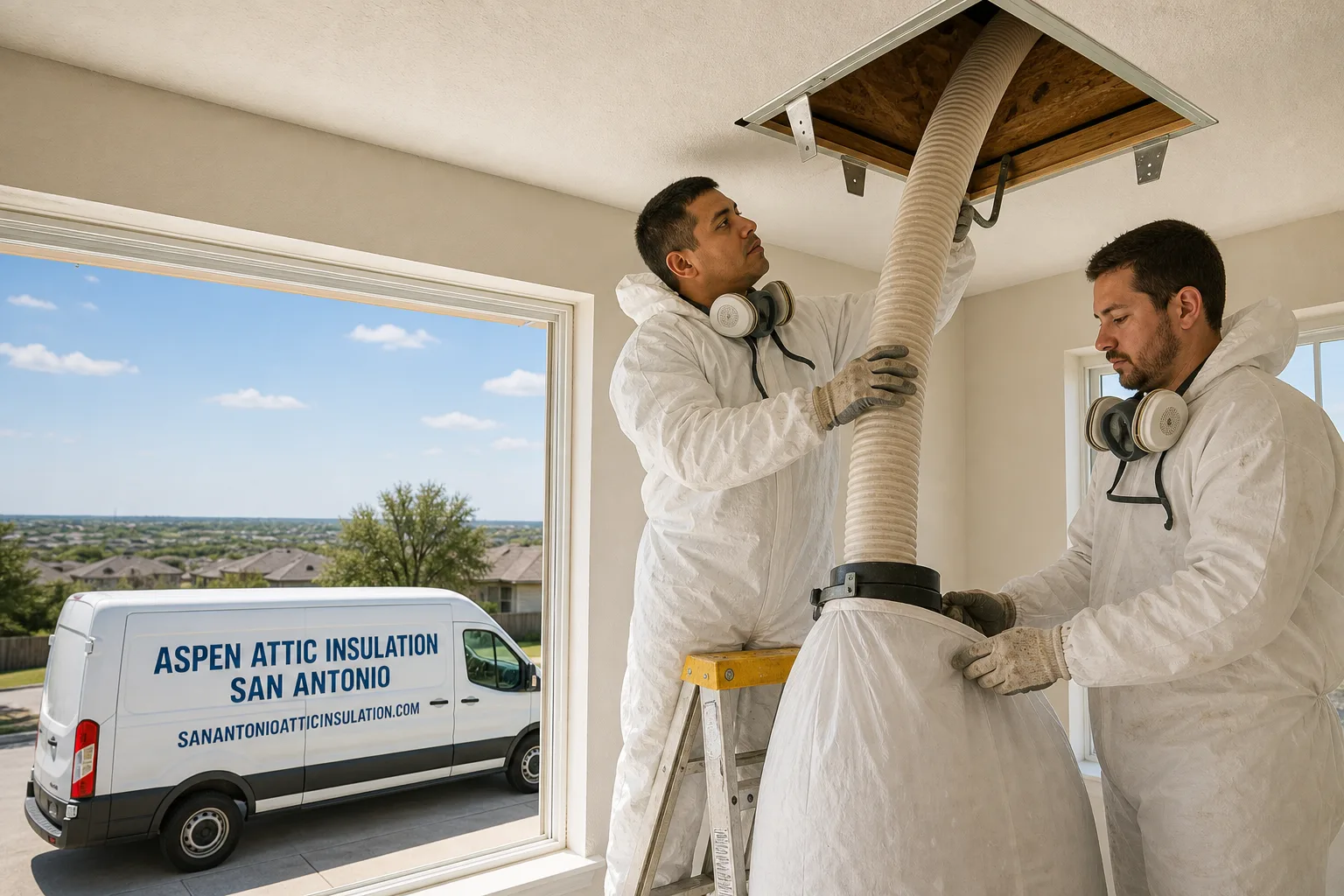
Fast, Reliable Attic Insulation Across Live Oak
Attic insulation in Live Oak usually means upgrading an older ranch home from R-11 or R-19 up to R-38 or better, with most jobs running $1,800 to $4,200 depending on attic size and material. We get calls from Live Oak homeowners every week whose cooling bills are $60 to $120 higher than they should be in July because settled fiberglass has lost its loft. Our crews know the Toepperwein Road corridor, the neighborhoods off Judson Road, and the streets around Live Oak Park. We show up on time, with a written price in your hand before anything goes into your attic. Call (361) 213-9499 and a live person answers, day or night.
What makes Live Oak different from other San Antonio-area suburbs is the age and construction of the housing stock. Most homes here went up between 1970 and 1995 as single-story brick veneer ranches on slab foundations. Builders in that era met the codes of the day, which meant R-11 to R-19 attic insulation and often nothing in the exterior walls. South Texas summers do not care about old building codes. The result is predictable: long AC runtimes, uneven room temperatures, and attics that hit 140°F in August.
Why Aspen Attic Insulation San Antonio Is Live Oak’s Preferred Attic Insulation Company
We have been insulating attics in Live Oak long enough to know exactly what we will find when we climb the ladder. The settled blown-in fiberglass from the 1980s. The batt insulation near the old Live Oak Creek floodplain that wicked moisture all spring. The bathroom exhaust fans venting directly into the attic instead of through the roof. None of this surprises us, and none of it changes the price we quoted.
Every technician who arrives at a Live Oak home is background-checked, identity-verified, and uniformed. Before the visit, you receive the tech’s name and photo so you know who is knocking. If someone else shows up, the visit is free and we make it right. That protocol is called the Threshold Standard, and it applies to every job we run in Live Oak, no exceptions. Garrett Sloane set that rule because he knows what it feels like to open the door to a stranger. He does not think you should have to guess.
Live Oak homeowners tell us the same things in reviews. They mention the written price. They mention the tech arriving with a photo ID badge and a clean marked uniform. They mention the attic being cleaner when we left than when we arrived. Those are not accidentals. They are the way we operate, on every single job.
Response time to Live Oak is typically same-day or next-day for insulation assessments. Scheduling is coordinated from our San Antonio office, and crews serve Live Oak locally throughout the week. When you call, a live person answers. No voicemail loop, no call-back window.
Attic Ventilation in Live Oak
Attic Ventilation in Live Oak is not optional add-on work; it is the difference between insulation that performs and insulation that quietly fails under South Texas humidity. A vented attic needs balanced intake and exhaust airflow to keep the space dry and close to outdoor temperature. In Live Oak, where spring rains raise ambient humidity and summer heat drives attic temperatures past 130°F, inadequate ventilation causes condensation on roof sheathing, mold growth, and insulation that loses R-value because it is damp. We inspect soffit vents, gable vents, ridge vents, and any existing powered fans, then calculate net free vent area against the attic’s square footage.
Typical attic ventilation work in Live Oak runs $450 to $1,300, depending on whether we are adding ridge vent, upgrading soffit vents, or installing a powered gable fan.
Solar-Powered Gable Fans for Live Oak’s Heat Load
A solar gable fan moves hot attic air out without adding a cent to your electric bill. In Live Oak’s long cooling season, that is meaningful. We install fans sized to the attic’s cubic footage, wired to a small roof-mounted solar panel, and set to run when attic temperature crosses a threshold. Many Live Oak homeowners pair this with new insulation for a combined drop in upstairs heat gain.
Condensation Control Near the Floodplain
Homes on Live Oak’s east side, close to the old creek floodplain, deal with a humidity pattern that drier neighborhoods do not. Wet springs push moisture into attic air, and without proper ventilation, that moisture condenses on cooler surfaces and soaks into batt insulation. We have pulled back baffles on streets off Toepperwein Road and found batts compressing to half their original loft. Proper ventilation breaks that cycle.
Radiant Barrier in Live Oak
Radiant Barrier in Live Oak attacks the primary source of attic heat gain: solar radiation beating down on composition shingle roofs all summer long. A radiant barrier is a reflective material installed on the underside of roof rafters that reflects radiant heat before it can radiate into the attic space and then into your living areas. In Live Oak’s mid-90s summer highs, a properly installed radiant barrier can cut attic temperatures by 20 to 30 degrees, which directly reduces the load on your AC system.
Radiant barrier installation in Live Oak typically runs $1,100 to $2,600 for an average single-story ranch home, depending on attic square footage and roof geometry.
Reflective Foil vs. Sprayed Radiant Coatings
We install foil-faced radiant barrier in Live Oak attics because it holds up better in high-humidity environments than sprayed coatings. The foil gets stapled to the underside of the rafters, leaving an air gap that is essential for reflectivity. Some Live Oak homeowners ask about radiant barrier paint or spray-on products. We carry them, but for the humidity levels near the I-35 corridor, foil is the more durable answer in our experience.
Pairing Radiant Barrier with Blown-In Insulation
A radiant barrier and blown-in insulation do different jobs. The barrier handles radiant heat; the insulation handles conductive and convective heat. Live Oak homes that get both see the biggest drop in cooling costs because the attic stays cooler, which means the insulation below it does not have to fight as hard. We often recommend both when we inspect a 1970s or 1980s ranch with R-11 or R-19 in the attic.
Trusted Brands We Service in Live Oak
We stock and install insulation from Owens Corning, Johns Manville, and Demilec, which means we are not stuck pushing one product into every Live Oak attic. What works in a 1974 brick ranch off Judson Road is not necessarily what works in a 1992 two-story near Live Oak Park. We carry eight premium brands total so the right material goes in, not just the one on the truck. For most Live Oak retrofits, we recommend Owens Corning AttiCat blown-in fiberglass or Johns Manville batts depending on the attic layout and access.
Common Attic Insulation Problems We See in Live Oak Homes
- Settled blown-in fiberglass losing its loft. Fiberglass blown in during the 1980s and 1990s settles over decades in Live Oak’s hot attics, dropping effective R-value from R-19 to as low as R-11. The label says one thing, the thermal performance says another.
- Moisture-wicking batt insulation near the old Live Oak Creek floodplain. Wet springs push humidity into attics on the east side of town, and fiberglass batts absorb that moisture. The result is compressed insulation with reduced R-value and ceiling drywall stains that homeowners mistake for roof leaks.
- Inadequate ventilation trapping humid air. Without balanced soffit-to-ridge airflow, Live Oak attics hold onto the humidity that storms bring in. That breeds condensation on roof sheathing and mold growth before and after every wet season.
- Bathroom exhaust fans venting directly into the attic. This is a live problem in Live Oak’s older ranch homes. Hot, humid shower air gets dumped into the attic cavity, where it condenses on insulation and framing. We correct this on nearly every retrofit we do in the area.
Pricing for Attic Insulation in Live Oak, TX
Here is what Live Oak homeowners should expect to pay. Blown-in attic insulation to bring an R-11 or R-19 attic up to R-38 generally runs $1,800 to $3,400 for a typical 1,200 to 1,800 square foot ranch. Attic batt insulation replacement lands in the $1,500 to $3,000 range. A top-up over existing insulation runs $800 to $1,600. Radiant barrier installation runs $1,100 to $2,600, and attic ventilation work runs $450 to $1,300 depending on the fan or vent configuration. Attic baffles and ventilation prep before insulation runs $200 to $600. These are real ranges for this market, not national averages. Every quote we give in Live Oak is a written price delivered before any work starts. Call (361) 213-9499 for a free estimate.
We Also Serve Cities Near Live Oak
Our Attic Insulation crews work throughout the northeast San Antonio corridor. Beyond Live Oak, we serve Schertz, Universal City, and Helotes with the same written-price guarantee and background-checked technicians. If you are one town over, the drive time is short and the standard is identical.
Serving Live Oak, TX - Our Local Coverage Area
We’re based in the Live Oak area and know this community well. Use the map below to see our service coverage - if you’re nearby, we can almost certainly help.
FAQs About Attic Insulation in Live Oak
Because builders in that era met the building codes that existed then, and those codes required far less attic insulation than today’s standards. Live Oak’s housing boom happened between 1970 and 1995, and most of those single-story brick veneer ranches were insulated to R-11 or R-19. Current code calls for R-38 or higher in this climate zone. The gap between what was code then and what is code now is exactly why retrofitting makes so much sense in Live Oak: your AC is fighting heat gain that modern insulation standards were designed to stop. Call (361) 213-9499 and we will inspect what you actually have up there.
High humidity from wet springs can wick into batt insulation near the old Live Oak Creek floodplain, reducing its R-value and staining ceiling drywall. Watch for water marks on ceilings that are not tied to a roof leak, and for rooms that feel muggy even when the AC is running. Those are warning signs that attic insulation is holding moisture. We see this pattern regularly in Live Oak’s eastern neighborhoods, less so in Universal City next door. If you notice it, call us before the next storm season.
Yes. Insulation slows heat transfer, but ventilation is what prevents moisture from destroying that insulation over time. Live Oak’s humidity cycles mean a poorly vented attic will eventually compromise even good insulation. Condensation on roof sheathing, mold, and damp batts are all ventilation failures, not insulation failures. We inspect ventilation as part of every attic assessment in Live Oak, regardless of insulation condition.
In most Live Oak ranch homes built between 1970 and 1995, yes. Radiant barrier reflects heat from the roof before it can radiate down into the attic and then into your living space. Attic temperatures can drop 20 to 30 degrees, which means your AC runs less. The effect is strongest in attics with composition shingle roofs and no shading, which describes a large portion of Live Oak’s housing stock. Pair it with R-38 insulation and the difference is measurable on your summer electric bills.
Expect our crew to vacuum out the old settled material, air-seal the top plates and any plumbing or electrical penetrations, correct any bathroom fan venting, and then blow in new insulation to R-38 or higher. We lay drop cloths, wear respirators, and clean up before we leave. The job typically takes half a day for a standard Live Oak ranch. You will have a written price before we start, and the work is covered by our 365-Day Done Right Promise in writing. If it fails within a year, we come back free.
Written by Garrett Sloane, Owner at Aspen Attic Insulation San Antonio, serving Live Oak and the surrounding communities with written pricing and verified technicians.