
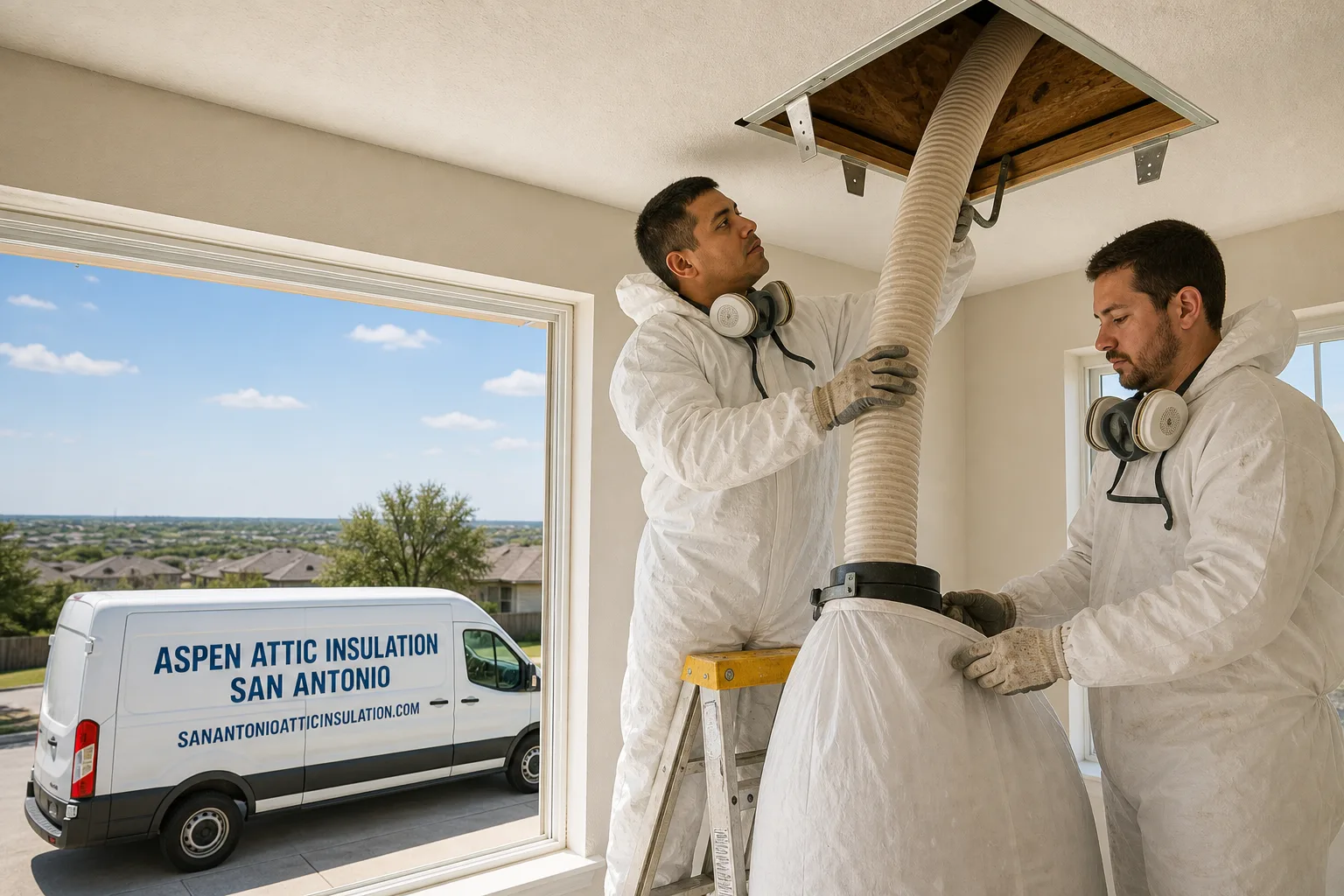
How Much Does Spray Foam Insulation Cost in San Antonio?
Spray foam insulation in San Antonio typically costs $2.75 to $5.50 per board foot for open-cell foam and $4.50 to $8.00 per board foot for closed-cell foam, installed. For a standard 1,500-square-foot attic, that translates to roughly $4,800 to $9,600 for open-cell or $7,200 to $14,400 for closed-cell. Most San Antonio homeowners we work with spend between $5,500 and $11,000 total, depending on the areas being sprayed, the foam depth required, and whether old insulation needs removing first.
Every spray foam job in the San Antonio market gets a written price before any material touches your home. That’s how we work, and it’s the only way we’d recommend anyone work: you see the number, you agree to the number, and that number doesn’t change at the end of the day.
Key Takeaways
- Typical spray foam costs in San Antonio run $2.75 to $8.00 per board foot installed, with open-cell on the lower end and closed-cell higher.
- A full attic spray on a 1,500-square-foot home averages $4,800 to $14,400 depending on foam type and depth.
- San Antonio’s hot-humid climate makes closed-cell foam a common upgrade for its built-in vapor barrier, but open-cell works well for budget-sensitive attics.
- A written estimate is free, and a live person answers the phone around the clock at (361) 213-9499.
- Every job carries a 365-Day Done Right Promise in writing, covering labor and materials for a full year.
Spray Foam Insulation Cost Breakdown (2026)
Here’s how spray foam pricing lands in the San Antonio market as of 2026. These are installed prices, meaning the material, labor, prep work, and cleanup are all included:
| Area / Project | Typical San Antonio Price |
|---|---|
| Open-cell spray foam (attic, walls) | $2.75 – $5.50 per board foot |
| Closed-cell spray foam (attic, walls, floors) | $4.50 – $8.00 per board foot |
| 1,500 sq. ft. attic, open-cell (6″ depth) | $4,800 – $9,600 |
| 1,500 sq. ft. attic, closed-cell (3″ depth) | $7,200 – $14,400 |
| 2,500 sq. ft. attic, open-cell | $7,800 – $15,000 |
| 2,500 sq. ft. attic, closed-cell | $11,500 – $22,000 |
| Rim joist sealing (200 lineal ft.) | $1,800 – $3,600 |
| Metal building / shop (1,200 sq. ft., closed-cell roof deck) | $6,000 – $12,000 |
| Old insulation removal and disposal | $1.00 – $2.25 per square foot |
Those are real numbers pulled from the work we’ve priced across San Antonio neighborhoods over the past few years. We spray attics in Alamo Heights, basements and rim joists in Stone Oak, and metal buildings out toward Boerne and Helotes, and the pricing holds pretty steady across the city. What moves the needle most is foam type, area size, and whether we’re working around existing insulation or starting fresh.
A note on depth, because this confuses a lot of homeowners: open-cell foam is typically installed at 5 to 6 inches thick in an attic to hit the R-value that matters, while closed-cell achieves the same or better insulating power at around 3 inches because it’s denser. So open-cell has a lower per-board-foot price but requires more material volume. Closed-cell costs more per board foot but often needs less of it to do the job. In San Antonio’s climate, where attic temps climb past 130 degrees from June through September, the right foam at the right depth makes a noticeable difference on your CPS Energy bill.
What Affects Spray Foam Insulation Pricing in San Antonio
- Foam type: open-cell vs. closed-cell. Closed-cell runs 50% to 80% more per board foot because it’s denser, acts as a structural stiffener, and includes an integral vapor barrier. Open-cell is the workhorse for attics on a budget and still seals air beautifully.
- Area being sprayed. Attics are the most common San Antonio spray job, but rim joists, crawlspace walls, and metal building roofs all have different prep and access challenges that shift the price. Rim joists are fiddly work in tight spaces, so labor runs higher per board foot than a wide-open attic deck.
- Existing insulation situation. If your 1980s Alamo Heights home still has blown fiberglass from a previous decade, it has to come out before we can spray. Removal and disposal adds $1.00 to $2.25 per square foot, which is worth knowing before you get a quote that looks suspiciously low.
- Access and attic geometry. Low-slope roofs, cramped scuttle holes, and attics full of ductwork all slow a crew down. Homes in older San Antonio neighborhoods, like Monte Vista or Olmos Park, tend to have tighter attic access than newer builds in Culebra Park or Westover Hills, and that shows up in labor hours.
- Depth and R-value targets. San Antonio sits in climate zone 2A, so code expectations are lower than in Dallas or Amarillo, but many homeowners here choose to overshoot minimums for comfort. More foam depth equals a bigger number on the written quote, plain and simple.
- Prep work and repairs. Rotted decking, old knob-and-tube wiring, or a leaky roof need to be addressed before foam goes down. We flag these things during the estimate, and the price for any necessary repair is included in writing before work starts, never added as a surprise after.
Open-Cell vs. Closed-Cell: What San Antonio Homeowners Should Know
Both foams seal air, and in a San Antonio summer, air sealing is the bigger win than raw R-value. Here’s the plain-language difference:
- Open-cell foam is softer, lighter, and costs less. It expands dramatically, filling every gap and sealing air leaks effectively. It’s not a vapor barrier, so in a humid Gulf-adjacent climate like San Antonio, it’s best paired with an existing vapor-retarding strategy or used in attics where ventilation handles moisture.
- Closed-cell foam is dense and rigid. It adds structural strength to the roof deck, acts as a vapor barrier on its own right, and delivers roughly double the R-value per inch. If you’re converting an attic to living space or spraying a metal shop, closed-cell is often the right call despite the higher price tag.
We stock materials from eight insulation manufacturers, including Icynene and Demilec for spray foam, Owens Corning and Johns Manville for batt and blown products, and Rockwool for fire-resistant applications. That means the foam recommendation you get is based on what your house actually needs, not on whatever one brand happens to be on the truck.
How to Save on Spray Foam Insulation in San Antonio
Spray foam is a premium insulation product, but there are legitimate ways to keep your number down without cutting corners:
- Get a written quote and hold every contractor to it. A lowball verbal estimate is worthless if the final invoice is 30% higher. At Aspen, the price you approve before work starts is the price you pay when the foam cures. That’s our standing rule, and it has been since 2002.
- Ask about blending foam types. Some jobs don’t need closed-cell everywhere. A hybrid approach, closed-cell on the roof deck and open-cell on gable walls, can cut cost while preserving the moisture-control benefits where it matters most. A good estimator will price both.
- Spray during a full attic insulation upgrade. If you’re already pulling out old insulation and air-sealing, that’s the moment to spray. Bundling the work avoids paying twice for access and prep.
- Check whether your project qualifies for utility rebates. CPS Energy has run insulation and weatherization programs in San Antonio that shift year to year. We will help you check, but the rebate isn’t guaranteed, so never price a job assuming it’s covered.
- Don’t overbuy depth you don’t need. More foam is better only up to a point. Beyond the R-value that makes sense for San Antonio’s climate zone, you’re paying for material that returns less and less each additional inch. We won’t oversell you foam. The written estimate will show the depth we recommend and the R-value it delivers.
If you want to know what your specific attic or walls would cost to spray, call us at (361) 213-9499. The estimate is free, and the number we give you is the number you’ll pay.
Why Attic Spray Foam Is a Bigger Deal in San Antonio Than in Cooler Climates
San Antonio’s summer heat is the reason spray foam makes sense here in a way it doesn’t in Ohio or Colorado. From May through late September, attic temperatures in a shingle-roof home routinely hit 130 degrees or higher. That heat radiates downward into the living space, your AC runs longer, and your upstairs bedrooms stay five to eight degrees warmer than the rest of the house. A sealed attic with spray foam stops that thermal transfer at the roof deck, not at the ceiling.
We see this all the time in two-story homes in neighborhoods like Encino Park and Rogers Ranch: the downstairs is fine, the upstairs is miserable, and the attic inspection shows fiberglass batts that never sealed anything. Spray foam changes that. It also handles the humid side of the equation. San Antonio gets 30 inches of rain a year and humidity that rarely drops below 50% in the mornings. Closed-cell foam creates a vapor barrier that keeps that moisture from condensing in the attic cavity, which matters a lot in older homes with tongue-and-groove roof decking.
For a deeper look at how spray foam performs in this specific climate, see our Spray Foam Insulation in San Antonio page. It walks through the foam application process for San Antonio homes and shows what a typical job looks like from estimate to cleanup, along with why a 2002-founded, threshold-standard operation runs things differently than the one-truck crews that dot the San Antonio area.
What You Get With Aspen Attic Insulation San Antonio
Here’s what comes with every spray foam job we price and perform, no exceptions:
- A written price before anything starts. No handshake estimates, no “we’ll see how it goes.” You get the number in writing, you approve it, and that’s the deal. If the job runs long because of something on our side, that’s our cost, not yours.
- The 365-Day Done Right Promise. If the foam doesn’t perform or a repair fails within a full year, we come back and make it right at no charge. That’s in writing, covering labor and materials, on every single job.
- The technician’s name and photo sent to you before the visit. You will know exactly who is showing up at your door, what they look like, and that they’ve been background-checked, identity-verified, and drug-screened. They arrive in a clean marked uniform and show a photo ID badge when you answer. If someone other than the named technician shows up, the visit is free and we make it right. That’s the Threshold Standard, and it’s non-negotiable at our San Antonio location.
- A live person on the phone, 24 hours a day. No phone trees, no voicemail loops, no waiting for a call back that never comes. Call (361) 213-9499 at any hour, and a person answers.
- Materials matched to the job. We stock eight brands, including Owens Corning, Johns Manville, Knauf, Rockwool, CertainTeed, Icynene, Demilec, and GreenFiber. The foam and batt we recommend is the product your house needs, not the product that happens to be loaded on the truck that morning.
Garrett Sloane, who leads our San Antonio location, sets the standard for how estimates and installations run. He’s the one who will make sure your written price is accurate down to the board foot and your technician arrives exactly as promised.
Spray Foam Safety: What to Know Before You Book
Spray foam installation is not a DIY project, and we’ll say that as plainly as possible. The two-part chemical reaction that creates the foam produces heat during application, and the A-side component (isocyanate) requires full protective equipment: supplied-air respirator, chemical-resistant suit, and proper ventilation controls. A professional crew also knows how to manage off-gassing after application and will tell you how long to stay out of the home before re-entry. We’re happy to walk you through every safety step during the estimate, but please do not attempt to spray foam yourself with a home kit from a hardware store. The risk to your lungs and the potential for a botched application far outweigh the savings.
This is also why you should care about who is in your home. Spray foam work requires a technician who is trained, equipped, and accountable. The name-and-photo protocol we follow, along with the background check and the written guarantee, is designed for exactly this kind of job: a significant investment in your home performed by a stranger you let through the door. We take that responsibility seriously because we’ve been doing this since 2002, and we know what it means to earn a homeowner’s trust.
FAQs – Spray Foam Insulation Cost
How much does spray foam insulation cost per square foot in San Antonio?
Installed spray foam in San Antonio runs $2.75 to $8.00 per square foot depending on foam type and depth. Open-cell lands at $2.75 to $5.50 per square foot, closed-cell at $4.50 to $8.00 per square foot. These are installed numbers that include materials, labor, and cleanup. Call (361) 213-9499 for a written quote on your specific project, free of charge.
Is spray foam insulation worth the cost in San Antonio?
For most San Antonio homeowners, yes. Attic temperatures here routinely exceed 130 degrees in summer, and spray foam stops that heat at the roof deck rather than letting it soak into your living space. Most homeowners see a 20% to 40% reduction in air-conditioning costs after spraying an unsealed attic, plus the comfort difference of even temperatures from room to room. The upfront cost is higher than fiberglass, but the sealed-air performance is in a different category. Call (361) 213-9499 and we’ll give you a written price so you can run the numbers for your own home.
How much does it cost to spray foam a 1,500 square foot attic?
A 1,500-square-foot attic in San Antonio costs $4,800 to $9,600 with open-cell foam or $7,200 to $14,400 with closed-cell foam, installed. That includes accessing the attic, prepping the surfaces, spraying the foam, and cleanup. Existing insulation removal, if needed, adds $1,000 to $3,375 depending on the attic’s condition.
Is closed-cell spray foam worth the extra cost in San Antonio’s humid climate?
Yes, in most cases. Closed-cell foam costs 50% to 80% more than open-cell, or roughly $4.50 to $8.00 per board foot, but it creates a built-in vapor barrier that matters in San Antonio’s high-humidity climate. If your attic has a history of condensation, or you’re converting it to living space or spraying a metal building, closed-cell is the right choice. For a budget-conscious attic seal on a ventilated roof, open-cell often gets the job done for less.
Can you spray foam an existing house without removing the old insulation?
In most San Antonio homes, old insulation needs to come out before new foam can be sprayed to the deck. Putting fresh spray foam over fiberglass or cellulose means the old material gets trapped and the foam doesn’t adhere properly. Removal and disposal adds $1.00 to $2.25 per square foot. Some rim joist and wall cavity jobs can be done without full removal. We’ll tell you during the estimate exactly what your house needs, and the written quote will include every line item.
How long does spray foam insulation last?
Professionally installed spray foam lasts 30 years or more without losing meaningful R-value. It doesn’t settle, sag, or shift the way blown fiberglass and cellulose do over time. In the San Antonio heat, that’s a real advantage: fiberglass batts that have been baking in a 130-degree attic for 15 years have lost much of their effectiveness. Spray foam stays where we put it. That’s why our 365-Day Done Right Promise covers labor and materials with confidence, and why we back every job in writing.
Get a Written Spray Foam Price in San Antonio
You should not have to guess what our Spray Foam Insulation services will cost, and you shouldn’t get a fuzzy verbal estimate that changes on invoice day. Call (361) 213-9499 and we will send a technician to your home, measure the spaces to be sprayed, and hand you a written price before any work begins. That written price includes the foam type, the depth, the R-value, the prep work, and the cleanup. It’s the number you’ll pay.
The technician’s name and photo will be sent to you before the appointment. They will arrive in a marked uniform, show a photo ID at the door, and treat your home the way you’d expect from someone accountable to a 365-Day Done Right Promise. If you’d rather talk through options first, we’re happy to answer your questions on the phone and give you a ballpark range. But for a firm number in writing, we’ll come out and see the space.
If you’re still deciding between spray foam and other approaches, take a look at our home page for an overview of the services we offer across San Antonio: attic insulation, blown-in insulation, and full spray foam work, all priced in writing before anything starts.
Written by Garrett Sloane, Owner at Aspen Attic Insulation San Antonio, serving San Antonio homeowners since 2002.
Pricing reflects the San Antonio market as of 2026. Aspen Attic Insulation San Antonio offers free estimates – call (361) 213-9499.
What Our Customers Say
"Blown in cellulose up to R-49 in the attic. Tech badged in at the door and measured the depth with a ruler before and after. Upstairs bedrooms stopped being an oven."
- Fran T."Spray foam in the rim joists of the crawl space. Clean install, and the floors are noticeably warmer."
- Chuck W."Honest assessment. Told me the walls were fine and the attic was the problem. Saved me money."
- Ed M.