
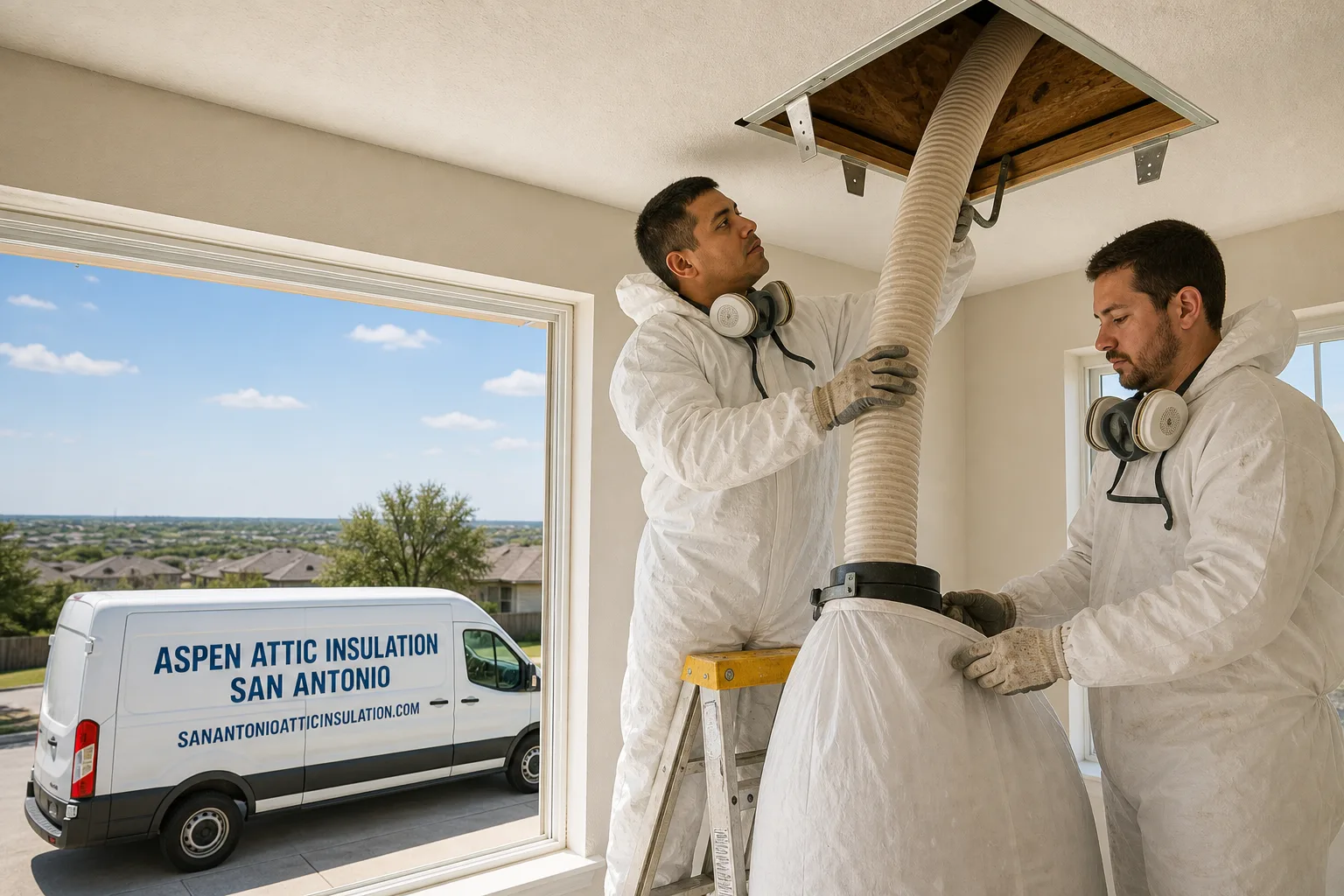
Fast, Reliable Blown In Insulation Across San Antonio
San Antonio homeowners call us when their upstairs rooms won’t hold temperature or their AC bill climbs every July. Blown in insulation in San Antonio typically costs $1,800 – $4,200 for a full attic job, and most homes are done in a single day. Our crews know the difference between a 1970s ranch off Bandera Road and a 1920s bungalow in Monte Vista, because the installation approach is not the same. If you’re tired of rooms that never feel right, call (361) 213-9499 and we’ll give you a written price before any work starts.
Why Aspen Attic Insulation San Antonio Is San Antonio’s Preferred Blown In Insulation Company
We’ve worked in enough San Antonio attics to know what’s actually up there. Homes across the north side, from Stone Oak to the Dominion, have the same story: blown fiberglass installed decades ago, settled to R-19 or worse, with gaps around every recessed light and attic hatch. Nobody’s ever looked until the electric bill got ugly or the second floor turned into a sauna by 3 p.m.
What sets us apart is the way we run every job. Garrett Sloane built Aspen Attic Insulation on a simple rule: the homeowner knows exactly who is coming and exactly what it costs before anyone touches the ladder. Every technician is background-checked, identity-verified, and photo-badged. When you book with us, we send the tech’s name and photo before the visit. The person at your door matches the photo, every time. That’s the Threshold Standard, and it’s not optional.
We carry a strong local reputation because we treat San Antonio homes like they’re our own. Older houses in Alamo Heights don’t get the same playbook as newer builds in Schertz. We show up in marked uniforms, answer questions in plain English, and never leave a surprise on the invoice. Our Blown In Insulation crew works on the house, not around it.
Blown In Cellulose Insulation in San Antonio
Blown In Cellulose Insulation in San Antonio is the workhorse for older brick-veneer homes where wall cavities are empty and attic coverage is thin. Cellulose is made from recycled paper fiber treated with borate, blown loose into attic floors or dense-packed into wall cavities. In San Antonio’s climate, it does two jobs at once: it slows heat moving down from the attic, and it fills odd-shaped cavities that fiberglass batts never touched. Homeowners in Terrell Hills and Alamo Heights often choose cellulose because it’s the only practical way to insulate walls without tearing out drywall. For a typical San Antonio ranch attic, cellulose runs $1,600 – $3,800 depending on square footage and target R-value. Dense-packed wall work costs more per square foot because of the drilling and patching.
Dense-Pack Wall Cavities
Most 1970s-era brick homes in San Antonio have empty wall cavities. The brick veneer goes up, the studs sit behind it, and nobody put anything between them. Dense-packing cellulose into those walls stops the thermal leakage that makes rooms on the west side of the house feel 10 degrees hotter in August. We drill from the exterior, blow the cellulose in under pressure, and patch the holes with mortar tinted to match the brick.
Attic Re-cover Over Settled Insulation
If your attic has old fiberglass that’s compressed to half its original thickness, adding a fresh layer of cellulose on top is usually the smartest move. It fills the gaps the old stuff left behind and brings the total depth up to current R-value recommendations for San Antonio. The old insulation doesn’t need to come out unless it’s wet or moldy.
Blown In Fiberglass Insulation in San Antonio
Blown In Fiberglass Insulation in San Antonio is what we recommend for open attics in newer homes, especially two-story traditional builds across the north and west suburbs. Fiberglass doesn’t settle as much as early formulas did, and it’s lighter per square foot than cellulose, which matters when you’re bringing an attic up from R-11 to R-38 or R-49. San Antonio homeowners choose fiberglass when they want fast coverage, a clean install, and a product that won’t hold moisture the way organic fibers can. For a standard 1,800-square-foot attic in San Antonio, blown fiberglass runs $1,400 – $3,200.
R-38 to R-49 Attic Upgrades
Most San Antonio attics built before 2010 sit around R-19 or less. That’s why the second floor never cools down. We blow fiberglass to a consistent R-38 minimum, and R-49 for homes with two AC units running constantly. The deeper the coverage, the longer your cooled air stays in the living space instead of bleeding through the ceiling.
Air Sealing Before Blowing
Blowing new fiberglass over gaps around recessed lights, attic hatches, and plumbing chases just buries the problem. Our crew air-seals those openings with foam and caulk before the insulation goes in. Without that step, humid San Antonio attic air still finds its way into the house and you’ll see condensation stains on the ceiling after a few seasons. San Antonio’s humidity is the reason we don’t skip this.
Trusted Brands We Service in San Antonio
We install GreenFiber cellulose and CertainTeed fiberglass most often in San Antonio, because they hold up well in high-humidity attics and we can get them locally without delays. For homes that need a different material, we also work with Demilec and other premium brands. The right product matters more than whatever’s on the truck. We stock enough local inventory to handle most San Antonio jobs without a second trip, and we’ll tell you straight if your attic needs something specific. The product goes on the written estimate before we blow a single bag.
Common Blown In Insulation Problems We See in San Antonio Homes
- Settled or wind-drifted fiberglass in sprawling ranch attics. Homes built from the 1970s through the 1990s across neighborhoods like Churchill Estates and Oak Hills often have insulation depth under R-30 near the eaves, right where the air handler sits. That’s why the master bedroom never cools down even when the rest of the house does.
- Insulation installed without air sealing. Gaps around recessed lights, attic hatches, and vent pipes let humid San Antonio attic air condense against the ceiling drywall. You’ll see faint brown rings around the light fixtures. New insulation alone won’t fix it.
- Uninsulated wall cavities in older brick homes. In Terrell Hills, Alamo Heights, and Monte Vista, we regularly find empty voids behind the brick veneer. The house looks solid from the street but the walls are hollow. Heat pours through them all afternoon.
- Uneven coverage from previous crews. We see attics where a contractor blew insulation over visible stud bays but skipped the diagonal braces and fire-blocked sections. Those hidden gaps leave vertical stripes of hot wall that show up on a thermal camera. Our crew checks with an infrared scan before we call the job done.
Pricing for Blown In Insulation in San Antonio, TX
A typical blown-in attic insulation job in San Antonio runs $1,600 – $3,800 for cellulose and $1,400 – $3,200 for fiberglass, based on a 1,500 to 2,200-square-foot attic. Dense-packed wall retrofits in older brick homes run $3.50 – $6.00 per square foot of wall area because of the drilling, blowing, and mortar-matching work involved. The big cost variables are attic access, existing insulation depth, whether air sealing is needed, and how much of the attic is walkable. Every Aspen job comes with a written price before work starts. No post-job surprises, ever. Call (361) 213-9499 for a free estimate and a firm number in writing.
We Also Serve Cities Near San Antonio
Our crews cover San Antonio and the surrounding suburbs daily, including Universal City, Schertz, Helotes, and Bulverde. If you’re just outside the city limits and wondering whether we’ll come out, the answer is yes. We schedule work across the metro so homeowners in those areas get the same written price and photo-badged techs as everyone we serve in San Antonio.
Serving San Antonio, TX - Our Local Coverage Area
We’re based in the San Antonio area and know this community well. Use the map below to see our service coverage - if you’re nearby, we can almost certainly help.
FAQs About Blown In Insulation in San Antonio
Because the walls are usually empty. Brick veneer construction from the 1920s through the 1960s rarely included wall insulation, so the cavity between the brick and the interior drywall is just dead air. Attic insulation helps with ceiling heat loss, but it does nothing for the afternoon heat radiating through uninsulated walls on the west and south sides. Drilling from the exterior, dense-packing the cavities, and patching with color-matched mortar is the only way to insulate those walls without tearing out interior drywall. Call (361) 213-9499 and we’ll tell you if your house is a candidate.
A full R-38 to R-49 blown-in attic layer is enough for most San Antonio homes to see a real difference in comfort and cooling cost. Radiant barrier helps too, especially on west-facing roof slopes in single-story ranch homes where the sun beats on the shingles from noon until 8 p.m. The two work together, but if you’re choosing one because of budget, get the blown-in insulation done first. It addresses the whole attic, not just the roof deck. We’ll give you a straight answer on whether radiant barrier is worth it for your specific house.
Measure the depth. If you can see the tops of your ceiling joists in most of the attic, you’re probably sitting at R-11 to R-19 instead of the R-38 or more a San Antonio attic needs. Other signs are rooms that won’t hold temperature, an AC that runs constantly in the late afternoon, and dust or fiberglass air leaking through recessed light fixtures. We do a free attic inspection and will show you the depth, the coverage gaps, and exactly what we recommend. No pressure, just the facts, in writing.
No. Cellulose is treated with borate, which is a natural mold inhibitor and also a fire retardant. The real mold risk in San Antonio attics is moisture from air leaks, not the insulation itself. If a bathroom fan vents into the attic or a roof leak drips onto the insulation, you can get mold with any material including fiberglass. That’s why our crew checks for moisture and air movement problems before we blow anything. Dry cellulose in a properly vented attic stays dry.
Yes. We drill small holes through the mortar joints from the outside, blow the insulation into the wall cavities under pressure, then patch each hole with mortar tinted to match the surrounding brick. Our crew recently worked on a 1980s ranch in Alamo Heights where the upstairs rooms never held temperature. We found empty wall cavities behind the brick veneer, drilled and blew in GreenFiber cellulose from the exterior, and tinted the mortar so the patches disappear. The upstairs now holds temperature without touching the drywall inside. For most brick homes in San Antonio, this is a one-day job with minimal disruption.
Schedule Your Blown In Insulation Estimate in San Antonio
You’ll get a written price before any work begins, a photo and name of your technician before they arrive, and the 365-Day Done Right Promise in writing with every job. If it’s not done right, we make it right, and that guarantee covers labor and materials for a full year. Call (361) 213-9499 to talk to a live person and schedule your free attic inspection. That’s the way Garrett Sloane has run Aspen Attic Insulation San Antonio since day one, and it won’t change.
Written by Garrett Sloane, Owner at Aspen Attic Insulation San Antonio.