
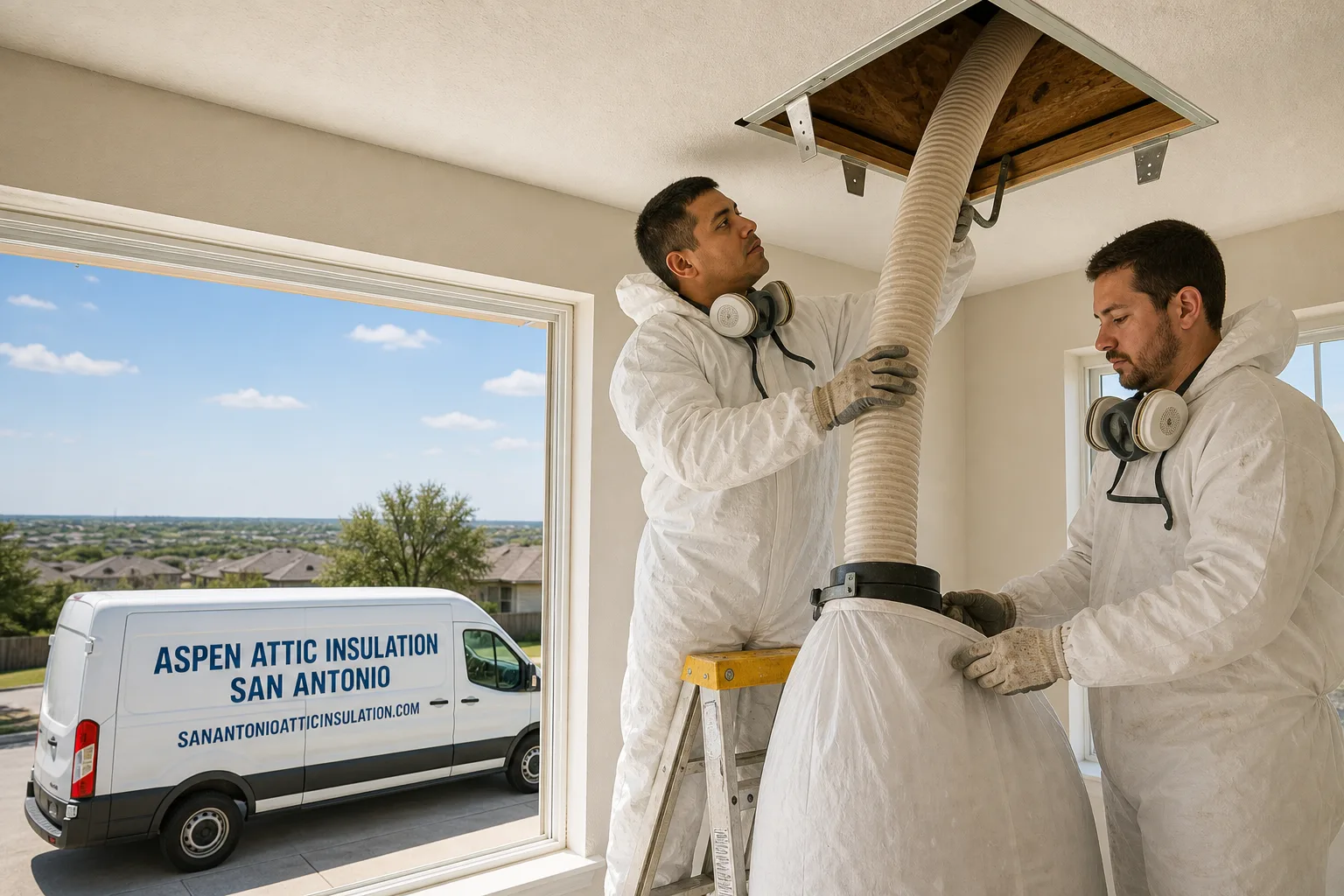
Fast, Reliable Blown In Insulation Across Schertz
Blown in insulation in Schertz typically costs $1,400 to $3,200 for a standard attic top-off, and most jobs are completed in a single day. If your attic has settled fiberglass or code-minimum coverage, adding blown in insulation is the fastest way to stop heat pouring through your ceiling. We serve every corner of Schertz, from the ranch homes off FM 1518 to newer subdivisions east of I-35. Call (361) 213-9499 and a live person answers, day or night.
Why Aspen Attic Insulation San Antonio Is Schertz’s Preferred Blown In Insulation Company
Schertz homeowners deal with a specific problem: split housing stock. Older ranch homes built in the 1970s through 1990s have original batt insulation that has settled to a fraction of its rated R-value. Newer subdivisions on the east side have code-minimum blown-in fiberglass that passes inspection but underperforms in July. Our crews know the difference before they climb the ladder. That local knowledge shows up in how we scope the job, what we recommend, and what we warn you *not* to spend money on.
Every technician we send to Schertz is background-checked, identity-verified, and photo-badged. Before the visit, you get the tech’s name and photo. If anyone else shows up at your door, the visit is free and we make it right. That’s the Threshold Standard, and it exists specifically for homeowners who don’t want a stranger walking through their house on a promise. Every job carries a written price before any work starts, and the 365-Day Done Right Promise covers labor and materials for a full year. If a repair fails, we come back free.
Blown In Fiberglass Insulation in Schertz
Blown in fiberglass insulation in Schertz is the most common attic upgrade we install, because it handles our specific heat load well and costs less than spray foam. It’s loose fiberglass fibers blown into the attic cavity to fill every gap, settled evenly across the floor joists. In a Schertz attic, we typically bring depth up to R-38 or R-49 depending on the home’s orientation and venting, and the job moves fast. Most ranch homes off FM 1518 or near Wiederstein Road are done by early afternoon.
Fiberglass Top-Offs for 1970s-1990s Ranches
Many Schertz homes west of I-35 still have their original batts, which compact to half their rated R-value after 25 to 40 years. We blow fiberglass directly over the settled batts to restore full attic depth without tearing out the old material. The work costs less than a full removal and gives you the same thermal performance.
Attic Air Sealing with Blown-In Fiberglass
Before we blow fiberglass, we seal the attic floor penetrations: wire chases, plumbing stacks, and the gap around the furnace flue. In Schertz’s humid climate, unsealed attics pull conditioned air upward and introduce moisture. Sealing first is the difference between a top-off that works and one that just covers a leak.
Loose Fill Insulation in Schertz
Loose fill insulation in Schertz is the broader category that includes blown-in fiberglass and blown-in cellulose, selected by the specific attic condition rather than habit. We match the material to the job: fiberglass for most open attics with consistent joist spacing, and GreenFiber cellulose for tight, irregular cavities around ductwork and plumbing where its higher density helps. In Schertz attics with inconsistent soffit and ridge vent balance, the right loose fill material makes a measurable difference.
Cellulose for Tight, Older Attic Cavities
Older homes near the historic downtown have attics with odd angles, low sloped ceilings, and mechanical chases that make batt installation sloppy. Loose fill cellulose packs into those spaces, fills gaps that fiberglass can bridge over, and provides a modest air-sealing benefit due to its density. It’s often the best choice for a 1970s ranch with a coal-burning era floor plan and odd furnace placement.
When Loose Fill Alone Won’t Stop the Heat
In newer Schertz subdivisions east of I-35, where attics have code-minimum blown-in fiberglass but no radiant barrier, loose fill alone will not solve the problem. Attic temperatures in those homes can surpass 140°F in August, and adding R-value without addressing radiant heat gain leaves the bedrooms still warm by 4 p.m.
Trusted Brands We Service in Schertz
We stock material from Owens Corning, Johns Manville, Knauf, Rockwool, CertainTeed, Icynene, Demilec, and GreenFiber. That matters in Schertz because the right product changes by neighborhood: a home off Borgfeld Road with a steep roof and irregular rafter spacing takes a different product than a standard ranch off Schertz Parkway. We keep material staged for Schertz jobs so we don’t show up and improvise with whatever is on the truck. You get the product matched to the specific problem, not the one we happened to have loaded that morning.
Common Blown In Insulation Problems We See in Schertz Homes
- Settled batt insulation in 1970s-1990s ranch homes. Original fiberglass compresses to half its rated R-value after three decades. This is the most common problem we find west of I-35, especially in neighborhoods with expansive clay soil.
- Ceiling drywall cracks mistaken for foundation movement. In the neighborhoods west of I-35, where homes sit on expansive clay, settled insulation often compresses and leaves ceiling cracks that homeowners attribute to slab movement. Our techs check attic depth before anyone calls a structural engineer.
- Code-minimum blown-in fiberglass in newer east-side subdivisions. Production homes built in the 2000s and 2010s often have exactly the minimum attic insulation allowed by code, with no radiant barrier. Attic temperatures in those homes routinely exceed 140°F in summer, radiating heat into bedrooms and making AC systems short-cycle.
- Unbalanced soffit and ridge venting on hillside lots. Schertz homes on sloped terrain get uneven airflow through the attic. That creates hot spots where blown-in insulation alone cannot stop heat gain, even at proper depth. The fix requires a venting assessment plus the right insulation material.
Pricing for Blown In Insulation in Schertz, TX
We Also Serve Cities Near Schertz
Our crews cover the Schertz area and nearby communities including Universal City, San Antonio, Bulverde, and Helotes. If you’re in one of those areas, the same Blown In Insulation expertise and written-pricing standard applies. Scheduling is coordinated from our San Antonio office, with trucks dispatched to Schertz daily.
Serving Schertz, TX - Our Local Coverage Area
We’re based in the Schertz area and know this community well. Use the map below to see our service coverage - if you’re nearby, we can almost certainly help.
FAQs About Blown In Insulation in Schertz
On Schertz’s expansive clay soil, ceiling drywall cracks are usually the result of two things working together: moisture-driven soil movement and attic insulation that has compressed to a fraction of its original depth. When batts settle from R-30 to R-11 or lower, the attic floor becomes a thermal sieve and ceiling drywall expands and contracts with the temperature swings. A quick attic depth check tells us whether the insulation is the culprit before you spend thousands on a structural engineer. Call (361) 213-9499 and we’ll check your attic depth first.
If the attic lacks a radiant barrier, adding blown-in insulation alone typically will not solve afternoon heat gain in a Schertz summer. A 1990s ranch off FM 1518 with a vented attic and no radiant barrier will still see attic temperatures above 130°F even after topping off to R-38. We recommend adding a radiant barrier to the roof deck at the same time, which blocks a significant share of radiant heat before it ever reaches the insulation layer. The combined cost usually lands between $2,600 and $5,000 on a standard ranch.
Look for three signs: bedrooms on the east and west sides of the house are 5 to 8 degrees warmer than the hallway in late afternoon, the AC runs constantly between 3 and 7 p.m. in July, and your attic is noticeably hot to enter even at dusk. Newer Schertz subdivisions built in the 2000s and 2010s typically have the minimum code-required depth with no radiant barrier, which performs fine in October and poorly in August. We can measure your attic depth and compare it against what your home needs in a free visit.
In some cases, but not if the problem is venting or radiant heat. When front rooms stay cool and back rooms bake, the issue is often one of three things: settled insulation over the back section of the attic, a radiant barrier missing over the hotter roof plane, or soffit and ridge vents out of balance on a sloped lot. We can diagnose all three from inside the attic, and if the fix is insulation depth alone, a blown-in top-off handles it. If it’s radiant or venting, we’ll tell you before we sell you insulation.
For most Schertz attics, R-38 is the sweet spot for cost versus comfort, and R-49 makes sense if you have a second story, a west-facing roof plane, or a heat pump that already works hard in August. Going beyond R-49 in a Schertz attic delivers diminishing returns unless the home is fully air sealed and has a radiant barrier. We’ll measure your existing depth and give you a written price for exactly what your home needs, not a one-size-fits-all package. Call (361) 213-9499 for a free estimate.
Written by Garrett Sloane, Owner at Aspen Attic Insulation San Antonio.