
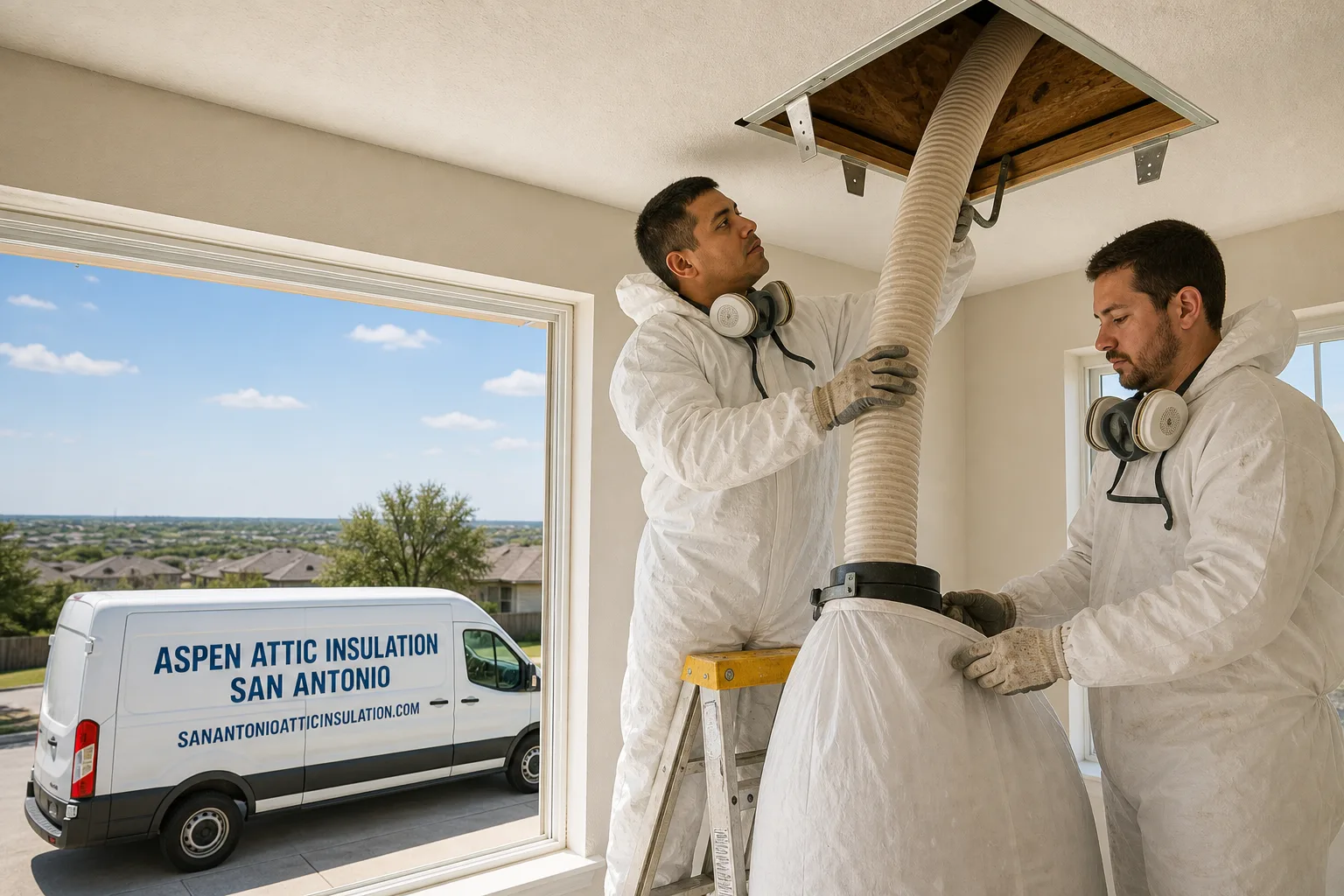
How Much Does Home Energy Audit Cost in San Antonio?
A home energy audit in San Antonio typically costs between $150 and $500 for most single-family homes, with the average falling around $250 to $350 for a comprehensive blower-door test plus infrared camera inspection. Larger homes over 3,500 square feet, older homes with multiple HVAC systems, and audits that include duct leakage testing can push the price to $600 or more. Our team at Aspen Attic Insulation San Antonio performs audits that include a written report with prioritized fixes, and we apply the audit fee toward any insulation work you hire us to do.
Here is the short version: expect to pay $150 to $500, budget for $300, and know that fixing what the audit finds – usually attic insulation and air sealing – is where the real savings show up on your CPS Energy bill.
Home Energy Audit Cost Breakdown (2026)
San Antonio pricing runs a bit lower than the national average because we have a competitive market and a long cooling season that keeps energy auditors busy from March through October. Here is what you can expect based on the type of audit you choose.
| Audit Component | Typical Cost in San Antonio | What You Get |
|---|---|---|
| Basic walkthrough inspection | $99 – $200 | Visual check of attic insulation levels, window and door seals, HVAC filter, and ductwork condition. No blower door test. |
| Blower door test only | $150 – $250 | A calibrated fan mounted in an exterior door frame measures exactly how much air leaks from your home. Takes 30 to 45 minutes. |
| Infrared camera scan | $100 – $200 (often bundled) | Thermal imaging shows missing insulation, air leaks, and moisture issues inside wall cavities and the attic floor. |
| Full diagnostic audit (blower door + infrared + duct test) | $300 – $500 | The standard comprehensive audit. Includes a written report, prioritized repair list, and energy savings estimates for each recommended fix. |
| Duct leakage testing (add-on) | $75 – $150 | Pressurized duct test shows how much conditioned air escapes into the attic before it ever reaches your rooms. |
| Large home surcharge (3,500+ sq ft) | $100 – $200 additional | Homes with multiple HVAC zones or complex layouts take longer to test and map. |
The full diagnostic audit is what most San Antonio homeowners schedule, and it is what we recommend. A walkthrough without a blower door test can miss 60% or more of the air leakage in a typical home, which means you end up guessing at fixes instead of knowing.
What drives cost up or down in San Antonio specifically:
- Home size and ceiling height. A 1,200-square-foot ranch in Harlandale takes about half the time of a 4,000-square-foot two-story in Stone Oak with vaulted ceilings and a second HVAC unit in the attic.
- Access difficulty. Attics with tight scuttle holes, low clearance, or blown-in insulation covering the attic floor make the infrared scan take longer and cost more.
- Number of HVAC systems. Each system needs its own duct test and airflow check.
- Season. Summer is peak season for auditors in San Antonio. You will get faster scheduling and sometimes lower pricing in the off-season months of November through February.
- Rebates and utility programs. CPS Energy occasionally offers discounted or free audits through partner contractors. Ask when you book.
Garrett Sloane and the team at Aspen Attic Insulation San Antonio include the audit fee as a credit toward any insulation work we perform. If the audit finds your attic insulation is at R-19 or lower – and plenty of San Antonio homes built before 1990 are – that credit effectively makes the audit free once you move forward on remediation.
What Affects Home Energy Audit Pricing in San Antonio
No two homes audit the same. Here are the factors that move the price in this market.
1. Home age and construction era
San Antonio housing stock spans adobe-style bungalows from the 1920s in Beacon Hill, mid-century brick ranches in Northwood built during the 1950s and 60s, and new builds in Alamo Ranch with spray foam already installed. Older homes almost always have thinner attic insulation, more air leaks, and more surprises – which means the audit takes longer and the report ends up longer too. A 1950s home with original single-pane windows and R-11 attic insulation is going to cost more to audit thoroughly than a 2015 build that just needs a quick verification scan.
2. Attic accessibility and insulation type
If your attic has a pull-down stair or a full-size access door, the auditor moves faster. If it is a 20-by-20-inch scuttle hole in a hallway ceiling in a Terrell Hills home with blown-in fiberglass covering every joist, expect the audit to run longer. Loose-fill fiberglass and old cellulose make it harder to see air leaks at the attic floor, so the infrared camera has to work harder – and takes longer – to map heat loss.
3. Number of stories and foundation type
Two-story homes in areas like Monte Vista and Olmos Park have more exterior wall surface and often more air leakage at floor transitions. Pier-and-beam foundations common in older San Antonio neighborhoods add crawlspace leakage that a slab foundation does not have. The auditor has to account for both.
4. Ductwork condition
The average San Antonio home loses 20% to 30% of conditioned air through leaky ducts, often in the attic where temperatures exceed 130 degrees in July. If your ductwork is original to the home, the audit will include a full duct leakage test and a more detailed camera scan of every connection – which takes time.
5. Time of year and scheduling flexibility
San Antonio energy auditors are busiest from May through September, when CPS Energy bills spike and homeowners notice rooms that will not cool. Booking in October through February usually means more scheduling flexibility and sometimes lower rates. If you can wait for off-peak scheduling, mention it when you call (361) 213-9499.
6. Scope of the report you need
Some homeowners want a quick “where is my air leaking” answer. Others want a document they can use to compare contractor bids and file for utility rebates. A detailed written report with prioritized fixes, estimated savings per fix, and insulation depth measurements costs more than a verbal summary – and it is worth every dollar when you are comparing quotes from three different contractors.
How to Save on Home Energy Audit
You do not need to overpay for a good audit in San Antonio, and there are a few ways to get the price down or get more value out of every dollar.
- Bundle the audit with insulation work. Most reputable San Antonio insulation companies, including Aspen Attic Insulation, apply the audit fee toward any remediation work you approve. If the audit finds insufficient attic insulation – and most homes built before 2010 in San Antonio have R-19 or less – you effectively get the audit at no cost.
- Check CPS Energy rebates before you book. CPS Energy has run residential energy efficiency programs that include discounted audits, insulation rebates, and duct sealing incentives. Ask your auditor if they participate in the current program year.
- Schedule off-peak. November through February is the slow season for energy auditors here. You are more likely to get a sooner appointment and sometimes a lower rate than during the summer rush.
- Prepare your home before the auditor arrives. Know where your attic access is, move stored items away from attic scuttles and crawlspace entries, and write down which rooms feel hottest in summer or coldest in winter. A prepared homeowner shortens the audit time, which can reduce the bill when the auditor charges hourly.
- Ask for a fixed-price quote, not hourly. Right now, ask the question: “Will you put the total price in writing before you start?” At Aspen Attic Insulation San Antonio, the answer is always yes – every homeowner gets a written price before any work begins. No surprises, no add-on fees when the invoice arrives.
- Get the free estimate on remediation work. The audit identifies the problem. The fix is a separate quote. Our estimates for attic insulation, spray foam, and blown-in insulation are free, and the audit fee you paid comes off the total if you proceed.
Call (361) 213-9499 and tell us your home’s square footage, age, and the rooms that feel uncomfortable. We will give you a straight answer on audit pricing and availability, free of charge, before you commit to anything.
What Your San Antonio Home Energy Audit Includes
When you hire Aspen Attic Insulation San Antonio for a full diagnostic audit, you are getting a specific set of tests, not a guy with a flashlight peeking into your attic. Here is what happens on audit day.
The blower door test
A calibrated fan is mounted in an exterior door frame, usually the front door, and the house is depressurized. The fan measures exactly how many cubic feet of air per minute leak through your walls, ceiling, floors, windows, and ducts. Most San Antonio homes built before 1990 test at 2,000 to 3,000 CFM at standard pressure – which means the house is effectively swapping all its conditioned air with outdoor air every hour. After insulation and air sealing, that number should drop below 1,200 CFM.
The infrared camera scan
While the blower door is running, the auditor walks every room with a thermal imaging camera. Missing insulation shows up as glowing hot rectangles in the ceiling. Air leaks at electrical outlets show as drafts. Poorly sealed can lights look like flashlight beams pointing into the room. The camera sees what a visual inspection cannot.
The attic inspection and insulation depth measurement
The auditor measures insulation depth in multiple locations across the attic. Fiberglass batt at R-19 is about 6 inches deep. Blown-in fiberglass needs to be 13 to 14 inches deep to hit R-38, which is the modern minimum for San Antonio’s climate zone. Most older homes here are at R-11 to R-19, which is less than half the current recommendation.
The duct leakage test
Ductwork in San Antonio attics routinely leaks 20% to 30% of the air you paid to cool. The test pressurizes the duct system and measures exactly how much air escapes before reaching the registers. This number goes in your report, and fixing it – through sealing or replacing ductwork – is usually one of the highest-return recommendations we make.
The written report with prioritized fixes
You get a written report that lists every finding, the measured data, and a prioritized list of fixes ranked by return on investment. The top items in San Antonio homes are almost always: air seal the attic floor, add insulation to R-38 or higher, seal duct connections, and address any bathroom exhaust fans venting into the attic instead of outside.
Why San Antonio Homes Need Audits More Than Most
San Antonio sits in a unique spot on the energy map. We run air conditioners from April through October, sometimes into November. CPS Energy’s residential rates have climbed steadily, and the average San Antonio electric bill runs higher than the national average during peak summer months. A home that leaks conditioned air into a 130-degree attic is not a minor inefficiency – it is a recurring tax on your monthly budget.
Here is what the audit data shows in this market. Homes in neighborhoods like Jefferson, Woodlawn Lake, and Beacon Hill, many built between 1920 and 1960, often have R-0 to R-11 in the attic if insulation was never added. Homes in suburban tracts built from the 1980s and 1990s, like parts of Helotes, Converse, and Universal City, typically sit at R-19 fiberglass batt that has compacted over time. Even homes built in the 2000s around Stone Oak and Alamo Ranch often have code-minimum insulation and leaking ductwork because production builders did not prioritize air sealing.
An audit gives you the exact numbers for your specific home, not a guess based on the year it was built. That is what makes the $300 to $500 worth it – you are buying data, not opinion.
Does a Home Energy Audit Actually Save Money?
Yes, and the math is not complicated. The audit tells you where your conditioned air is escaping. The fixes – air sealing, insulation, duct sealing – cut the amount of conditioned air you have to produce in the first place. San Antonio homeowners who follow the audit recommendations typically see a 15% to 30% reduction in cooling costs, which on a $250 average summer electric bill translates to $37 to $75 per month saved during the long cooling season.
Annualized, that is $300 to $700 in savings per year for most homes. A $400 audit that leads to $3,000 in insulation and air sealing work pays for itself in four to five years – and that is before factoring in CPS Energy rebates that can shorten the payback further. The audit is the cheapest part of the entire process, and it is the part that tells you exactly what to spend money on and what to skip.
One of the most common outcomes from our San Antonio audits: the homeowner learns that their attic insulation is fine but their ductwork is leaking badly. They spend $800 on duct sealing instead of $4,000 on new insulation. Without the audit, they would have spent the $4,000 and still had a hot house in August. That is the value of measurement before spending.
How to Choose a Home Energy Auditor in San Antonio
Not every energy audit is equal, and not every company that offers them will hand you data you can trust. Here is how we recommend evaluating any auditor in this market – including us.
- Ask if they use a calibrated blower door and infrared camera. If the answer is no, you are getting a visual inspection, not a diagnostic audit. Visual inspections miss most air leakage and insulation defects.
- Ask what the written report includes. A good audit report has measurements, not just recommendations. Blower door CFM, insulation depth in inches, duct leakage percentage, and thermal images. If the report is one page of vague advice, you overpaid.
- Ask who is coming to your door. This matters more than most companies will admit. At Aspen Attic Insulation, every technician is background-checked, identity-verified, and arrives in a clean marked uniform showing a photo ID badge at the door. We send the technician’s name and photo to you before the visit. If anyone else shows up, the visit is free and we make it right. That is the Threshold Standard, and we put it in writing.
- Ask if the audit fee is credited toward remediation work. Many companies, including Aspen Attic Insulation, apply the audit fee to any insulation or sealing work you approve. This effectively makes the audit free when you move forward.
- Ask about the guarantee on any recommended work. An audit is only as good as the fixes it recommends. Every job we perform carries our 365-Day Done Right Promise in writing, covering labor and materials for a full year, with a free second visit if the repair fails. That is the guarantee in plain language: 365 days, written on every job, no fine print runaround.
Garrett Sloane built Aspen Attic Insulation San Antonio around a simple idea: know who is coming, know what it costs, and know that if something is not right, it gets made right. The audit is the first step in that process – it gives you facts about your home before you spend a single dollar on fixes.
What Happens After the Audit
The audit report is the roadmap. Here is what comes next, and what each step costs in the San Antonio market as of 2026.
Air sealing
Sealing the attic floor penetrations – plumbing vents, electrical chases, can light housings, and top plates – typically costs $800 to $1,800 for most San Antonio homes. This is the highest-return fix per dollar in most audits and the one we recommend doing before adding insulation. You cannot insulate over leaks and expect the problem to disappear.
Attic insulation
Bringing a typical San Antonio attic from R-19 to R-38 or R-49 costs between $1,800 and $4,500 depending on attic size and access. Blown-in fiberglass or cellulose is the standard approach. We carry products from Owens Corning, Johns Manville, Knauf, Rockwool, CertainTeed, and GreenFiber, and we match the material to your home rather than pushing one brand on every job.
Spray foam insulation
For attics with HVAC equipment and ductwork in the attic – common in San Antonio – spray foam at the roofline can perform better than traditional blown-in at the floor. Spray foam runs $4 to $8 per square foot and typically costs $5,000 to $12,000 for a full attic encapsulation. We use Icynene and Demilec closed-cell and open-cell products.
Duct sealing or replacement
Aeroseal or manual duct sealing costs $600 to $1,500. Full duct replacement in an attic runs $3,000 to $7,000 depending on home size and duct run length.
Every quote from Aspen Attic Insulation San Antonio includes a written price before any work starts. What we quote is what you pay – no add-ons, no “unforeseen conditions” fee when the job is done, no surprises. The 365-Day Done Right Promise covers every repair for a full year, and if something fails, the second visit is free.
FAQs – Home Energy Audit Cost
Is a home energy audit worth the cost in San Antonio?
Yes. At $150 to $500, an audit costs a fraction of what you will spend on the fixes it recommends, and it tells you exactly which fixes matter. Homes in San Antonio routinely see 15% to 30% reductions in cooling costs after following audit recommendations, which is $300 to $700 in annual savings for most households. The audit is the cheapest insurance against spending thousands on the wrong fix. Call (361) 213-9499 to get a firm price on a full diagnostic audit for your home.
How much does a CPS Energy home energy audit cost?
CPS Energy partner audits in San Antonio typically run $0 to $400 depending on the current program year and your home’s eligibility. Free or discounted audits are offered periodically through CPS Energy’s residential efficiency programs, usually with a participating contractor. When the free program pauses, a full diagnostic audit from an independent auditor runs $300 to $500. Call (361) 213-9499 and we will tell you what is currently available through CPS Energy and what a private audit would cost.
Can I get a free home energy audit in San Antonio?
Sometimes, yes. CPS Energy has offered free or reduced-cost audits through residential rebate programs, and some insulation contractors waive the audit fee when you proceed with remediation work. At Aspen Attic Insulation San Antonio, we credit the audit fee toward any attic insulation, spray foam, or air sealing work you approve – so the audit effectively costs nothing when you move forward. Call (361) 213-9499 for details on current availability.
How much does a blower door test cost in San Antonio?
A standalone blower door test in San Antonio costs $150 to $250. Most companies, including Aspen Attic Insulation, bundle the blower door test with an infrared scan and written report in a full diagnostic audit priced at $300 to $500. The bundle is the better value – the blower door shows how much air is leaking, and the infrared camera shows exactly where.
How long does a home energy audit take?
A full diagnostic audit takes 2 to 4 hours for most San Antonio homes, depending on attic access, home size, and the number of HVAC systems. The blower door test itself runs 30 to 45 minutes. The infrared scan and duct testing fill most of the remaining time. We schedule audits in a single visit, and you will have the written report within 48 hours after the testing is complete.
Is it cheaper to repair or replace attic insulation after an audit?
In most San Antonio homes built before 1990, replacing attic insulation is cheaper and more effective than trying to repair or “top off” old, compacted batt or settled blown-in material. Adding new blown-in insulation over existing, non-damaged material costs $1,800 to $3,500 for an average home. Full removal and replacement runs $3,000 to $5,000. The audit tells you which path applies to your attic. Call (361) 213-9499 for a free estimate on whichever route the data supports.
Get Your San Antonio Energy Audit Scheduled
A home energy audit in San Antonio is the fastest way to know exactly why your electric bill is high and which rooms will not hold temperature. You will get a written report with measured data – not guesses – and a prioritized list of fixes ranked by payback. And when you hire Aspen Attic Insulation San Antonio, you know before we ever arrive: the technician’s name and photo come to you in advance, the price is in writing before work starts, and the work is covered by our 365-Day Done Right Promise.
Founded in 2002 and part of the Threshold Group family, Aspen Attic Insulation San Antonio is led by Garrett Sloane and a team of background-checked, uniformed technicians who show a photo ID badge at every door. We carry materials from Owens Corning, Johns Manville, Knauf, Rockwool, CertainTeed, Icynene, Demilec, and GreenFiber – and we match the product to your home, not to what happens to be on the truck.
A live person answers the phone 24/7. Call (361) 213-9499, tell us your home’s square footage and the rooms that feel uncomfortable, and we will give you a straight answer on audit pricing and availability. If you want more detail on what an audit covers and what the report looks like, visit our Home Energy Audit in San Antonio page, or head back to our home page to see everything we offer.
Written by Garrett Sloane, Owner at Aspen Attic Insulation San Antonio, serving San Antonio since 2002.
Pricing reflects the San Antonio market as of 2026. Aspen Attic Insulation San Antonio offers free estimates – call (361) 213-9499.
What Our Customers Say
"The estimate was clear on R-value and cost per square foot. No add-ons."
- Omar N."Blown in cellulose up to R-49 in the attic. Tech badged in at the door and measured the depth with a ruler before and after. Upstairs bedrooms stopped being an oven."
- Fran T."Spray foam in the rim joists of the crawl space. Clean install, and the floors are noticeably warmer."
- Chuck W.